TYMK Blog

Toothpaste Private Label Manufacturer: The Smart Way to Build a Modern Oral Care Brand

<p>A complete guide to choosing the right Toothpaste Private Label Manufacturer for startups, D2C brands, MLM companies, and modern oral care businesses looking to scale with quality formulations and reliable production.</p><h2><br></h2><p><br></p>

29 May 2026 11 mins read

Toothpaste Private Label Manufacturer: The Smart Way to Build a Modern Oral Care Brand

Introduction

The toothpaste industry has changed dramatically over the last few years. Earlier, consumers mostly purchased products from large FMCG brands they already recognized through television advertisements and supermarket shelves. But today, the market works very differently. Customers are more informed, ingredient-conscious, and selective than ever before.

Modern buyers now compare herbal ingredients, fluoride-free formulations, charcoal variants, ayurvedic positioning, whitening solutions, packaging quality, and even sustainability before purchasing oral care products. This shift has opened massive opportunities for startups and emerging brands that want to enter the oral care market with differentiated products.

Because of this growing demand, many businesses are now launching their own toothpaste brands through private label manufacturing instead of building factories from scratch.

However, most people underestimate how technical toothpaste manufacturing actually is.

A toothpaste product may look simple from the outside, but behind every successful formulation there are ingredient balancing systems, texture consistency controls, flavor development, foam optimization, packaging compatibility testing, quality assurance processes, and large-scale production operations.

This is where a professional Toothpaste Private Label Manufacturer becomes extremely important.

Instead of investing heavily in factory infrastructure, machinery, chemists, production teams, and R&D systems, businesses can partner with experienced manufacturers that already have established operational infrastructure.

This allows brands to focus on:

  • Marketing
  • Branding
  • Distribution
  • Customer acquisition
  • E-commerce growth
  • Product positioning

while the manufacturing partner handles production complexity.

Now here’s the important part, most businesses realize very late.

Choosing the right manufacturer is not only about production.

It directly impacts product quality, customer retention, scalability, inventory consistency, and long-term brand reputation.

A weak manufacturing partner can create operational problems that damage a brand even before it properly scales.

That’s why modern oral care brands are increasingly choosing strategic manufacturing partnerships instead of simply searching for the cheapest supplier.


Table of Contents

  1. What is a Toothpaste Private Label Manufacturer?
  2. Why the Oral Care Industry is Growing Rapidly
  3. Why Private Label Manufacturing Matters Today
  4. How Toothpaste Manufacturing Actually Works
  5. Different Types of Toothpaste Products in Demand
  6. OEM vs Private Label vs Contract Manufacturing
  7. Real Manufacturing Challenges Most Brands Face
  8. Common Mistakes New Oral Care Brands Make
  9. Cost Factors in Toothpaste Manufacturing
  10. Packaging Psychology in Oral Care Branding
  11. How Manufacturers and Brands Actually Work Together
  12. Who Should Choose a Toothpaste Private Label Manufacturer?
  13. Why TYMK is Becoming a Preferred Manufacturing Partner
  14. Future Trends in Oral Care Manufacturing
  15. Featured Snippet
  16. FAQs
  17. Conclusion

What is a Toothpaste Private Label Manufacturer?

A Toothpaste Private Label Manufacturer is a company that manufactures toothpaste products, which are sold under another company’s brand identity.

In simple terms, the manufacturer produces the toothpaste while the business sells the product using its own branding, packaging, and marketing strategy.

This business model has become extremely popular because it allows companies to enter the oral care market without setting up expensive manufacturing infrastructure.

Instead of building factories and hiring technical teams, brands partner with manufacturers that already have:

  • Production machinery
  • Formulation expertise
  • Quality testing systems
  • Packaging infrastructure
  • Compliance processes
  • Ingredient sourcing networks
  • Bulk production capabilities

This reduces operational complexity significantly.

Professional manufacturers usually provide multiple manufacturing services depending on the business requirement.

Service Purpose
Product Formulation Herbal, ayurvedic, charcoal, whitening, sensitive-care formulas
OEM Toothpaste Development Fully customized toothpaste creation
Packaging Solutions Tubes, cartons, labels, eco-packaging
Quality Testing Stability and product consistency testing
Bulk Production Large-scale manufacturing support
Branding Support Private label customization
Regulatory Guidance Compliance and documentation support

In real-world business operations, private label manufacturing allows startups and mid-sized brands to compete like large FMCG companies without investing massive amounts into operational infrastructure.

That is one major reason why private label oral care manufacturing is growing rapidly across:

  • D2C brands
  • Wellness companies
  • Ayurvedic businesses
  • MLM companies
  • Pharmacy chains
  • Export businesses
  • Personal care startups

Why the Oral Care Industry is Growing Rapidly

The oral care market is no longer only about cleaning teeth.

Today, consumers associate oral care with wellness, beauty, hygiene, lifestyle positioning, and ingredient transparency.

People now actively search for products that align with their preferences and values.

Consumers increasingly look for:

  • Herbal ingredients
  • Sulfate-free formulations
  • Ayurvedic positioning
  • Vegan oral care
  • Fluoride-free products
  • Whitening solutions
  • Sensitive-care toothpaste
  • Sustainable packaging

This shift has changed the competitive landscape completely.

Earlier, most toothpaste products competed mainly on pricing and mass advertising. Today, niche positioning has become far more important.

For example:

A charcoal toothpaste brand may target premium beauty-conscious customers.

An ayurvedic toothpaste brand may focus on natural wellness consumers.

A whitening toothpaste brand may appeal to appearance-focused buyers.

A kids toothpaste brand may target parents looking for safer ingredient profiles.

This segmentation creates major opportunities for new brands because businesses no longer need to compete directly with multinational corporations across every category.

Instead, they can dominate specific niches.

This growing demand is one major reason searches related to:

continue increasing across Google Search and AI-driven search platforms.


Why Private Label Manufacturing Matters Today

Building a toothpaste factory independently is extremely expensive and operationally demanding.

A professional production setup requires:

  • Mixing machinery
  • Filling systems
  • Tube sealing equipment
  • Testing laboratories
  • Chemists
  • R&D teams
  • Ingredient procurement systems
  • Packaging infrastructure
  • Compliance management

For startups, this investment often becomes unrealistic.

This is exactly why private label manufacturing has become one of the fastest-growing business models in the oral care industry.

A professional Toothpaste Private Label Manufacturer helps businesses enter the market faster while reducing operational risk.

One of the biggest advantages is speed.

Brands can launch products much faster because the manufacturing infrastructure already exists.

Instead of spending years building facilities, businesses can focus directly on building the brand.

Another major advantage is lower financial risk.

Rather than investing heavily in machinery and production infrastructure, companies can allocate resources toward:

  • Branding
  • Digital marketing
  • Packaging
  • Customer acquisition
  • Distribution
  • Product positioning

This often creates better growth opportunities for startups.

Private label manufacturing also makes future product expansion easier.

Once the operational relationship is established, brands can quickly expand into:

  • Mouthwash
  • Tooth powder
  • Whitening products
  • Kids oral care
  • Herbal wellness products
  • Sensitive-care solutions

without rebuilding production systems.

Most importantly, businesses gain access to manufacturing expertise.

Experienced manufacturers already understand critical operational details such as:

  • Ingredient compatibility
  • Flavor balancing
  • Texture consistency
  • Foam stability
  • Shelf-life behavior
  • Packaging compatibility

These technical areas are commonly underestimated by first-time founders.

Even small formulation issues can create customer dissatisfaction and damage retention rates.


How Toothpaste Manufacturing Actually Works

Most online blogs oversimplify oral care manufacturing. Real production workflows are far more detailed.

The process usually starts with product positioning.

Before formulation development begins, businesses define their target audience, pricing strategy, ingredient positioning, packaging direction, and sales channels.

For example, a luxury D2C brand may focus on premium charcoal toothpaste with minimalistic packaging, while an MLM business may prioritize bulk scalability and affordability.

After positioning is finalized, formulation development begins.

Manufacturers may provide:

  • Existing formulations
  • Semi-custom formulas
  • Fully customized OEM Toothpaste development

This stage is extremely important because oral care consumers are highly sensitive to product experience.

Common customer complaints usually involve:

  • Poor aftertaste
  • Weak foam
  • Texture inconsistency
  • Excessive abrasiveness
  • Flavor instability

Professional manufacturers conduct multiple refinements before approving final production.

After formulation approval, sample testing begins.

Manufacturers test products for:

  • Texture consistency
  • Flavor stability
  • Foam performance
  • Temperature resistance
  • Shelf-life behavior
  • Packaging compatibility

Now here’s something many startups overlook.

Toothpaste formulations behave differently under heat exposure during transportation and warehousing. Weak production systems often fail during this stage.

Once testing is completed, packaging development begins.

Packaging strongly influences customer perception in oral care categories.

Consumers often judge quality within seconds based on:

  • Tube appearance
  • Typography
  • Cap design
  • Carton structure
  • Color psychology
  • Shelf presence

For example:

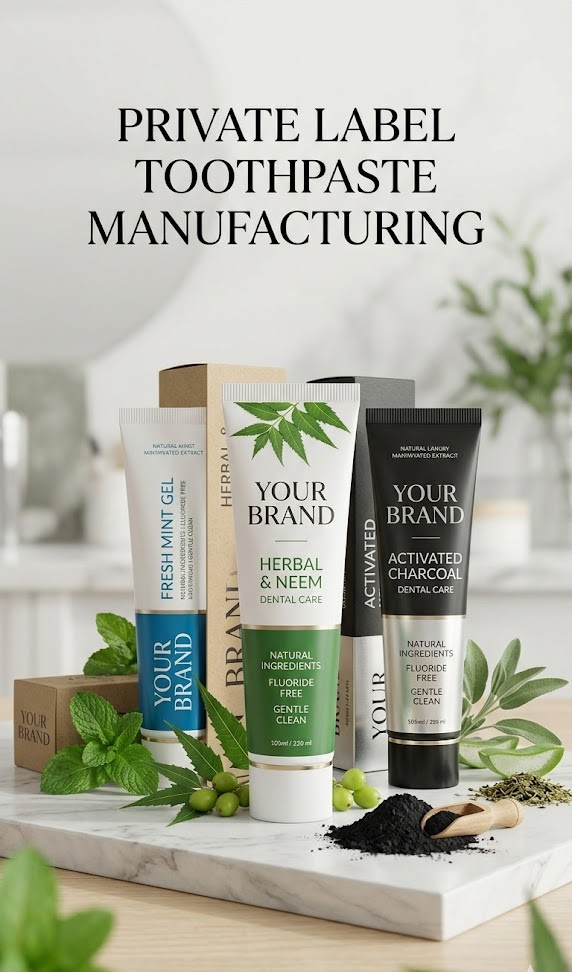
Green packaging often signals herbal positioning.

Black packaging suggests charcoal-based premium products.

White packaging communicates clinical trust and cleanliness.

These visual signals directly influence buying behavior.

After approvals are finalized, bulk production starts.

Ingredients are sourced, processed, mixed, filled into tubes, tested for quality, packaged, and prepared for dispatch.

Finished products are then distributed across:

  • Retail stores
  • E-commerce platforms
  • Pharmacy chains
  • Export channels
  • MLM distribution systems

At this stage, reliable manufacturing becomes critical because an inconsistent supply can damage brand trust quickly.


Different Types of Toothpaste Products in Demand

The oral care industry is becoming increasingly segmented as consumer preferences evolve.

Today, people buy toothpaste products based on lifestyle alignment rather than only basic functionality.

Some of the fastest-growing categories include herbal toothpaste, ayurvedic toothpaste, charcoal toothpaste, whitening toothpaste, sensitive-care toothpaste, vegan toothpaste, and fluoride-free formulations.

Herbal and ayurvedic categories are seeing particularly strong growth because consumers increasingly prefer natural wellness-oriented products.

Similarly, charcoal toothpaste has gained popularity among premium beauty-conscious audiences due to its cosmetic positioning.

Sensitive-care toothpaste is also growing rapidly as consumers become more aware of dental sensitivity and enamel protection.

This growing segmentation creates major opportunities for brands to establish strong niche positioning instead of competing directly with mass-market FMCG companies.


OEM vs Private Label vs Contract Manufacturing

Many businesses entering the oral care industry misunderstand the differences between OEM manufacturing, private label manufacturing, and contract manufacturing.

Private label manufacturing usually involves existing formulations that are customized with a company’s branding and packaging. This model is ideal for businesses that want faster market entry.

OEM Toothpaste manufacturing focuses on complete product customization. The formulation, ingredients, texture, flavor, and packaging are developed specifically for the brand. This model works best for companies looking to create highly differentiated products.

Toothpaste Contract Manufacturing generally refers to long-term production partnerships where manufacturers continuously produce products for a brand according to agreed operational requirements.

White-label manufacturing usually involves generic, ready-made formulations that multiple businesses can brand and sell.

The right manufacturing model depends on:

  • Budget
  • Timeline
  • Product uniqueness
  • Branding goals
  • Long-term scalability strategy

Real Manufacturing Challenges Most Brands Face

One of the biggest operational problems in oral care manufacturing is MOQ pressure.

Some manufacturers require very high minimum order quantities, which creates inventory risk for startups.

Formula inconsistency is another common issue.

Weak manufacturers often struggle to maintain consistency across production batches, which can damage customer trust once businesses scale.

Packaging delays also create major operational problems.

Tube procurement, carton printing, and packaging material shortages frequently delay launches and inventory replenishment.

Communication failures between manufacturers and brands can further complicate operations, especially when timelines are unclear.

Another major issue involves scalability.

Some manufacturers perform well with small production quantities but struggle once businesses begin scaling rapidly.

This is one reason why choosing manufacturers only based on low pricing often becomes a costly long-term mistake.


Common Mistakes New Oral Care Brands Make

Many startups focus too heavily on manufacturing costs while ignoring brand positioning and customer experience.

Competing only on pricing rarely creates long-term loyalty in modern oral care markets.

Another common mistake is a weak packaging strategy.

Consumers strongly associate packaging quality with product credibility, especially in premium oral care categories.

Many startups also launch too many SKUs too early.

Instead of building one strong hero product, they spread resources across multiple weak product lines.

Ingredient transparency is another area businesses often underestimate.

Modern consumers care deeply about what goes inside oral care products, and brands that fail to communicate ingredients clearly often struggle with trust-building.

Finally, choosing inexperienced manufacturers creates operational instability that becomes increasingly difficult to fix later.


Why Choose TYMK for Toothpaste Manufacturing?

TYMK supports startups, wellness businesses, D2C brands, MLM companies, and oral care entrepreneurs with scalable private label and OEM manufacturing solutions.

What makes TYMK different is the focus on long-term brand scalability rather than only basic product manufacturing.

The company supports businesses with formulation development, packaging guidance, production scalability, and operational manufacturing support designed for modern oral care markets.

TYMK helps brands develop multiple oral care categories including:

  • Herbal toothpaste
  • Whitening toothpaste
  • Ayurvedic oral care
  • Sensitive-care products
  • Charcoal toothpaste
  • Premium oral care formulations

The company also supports scalable production systems suitable for both startups and growing businesses.

Many manufacturers simply produce products.

Strategic manufacturing partners help businesses scale sustainably while maintaining quality consistency and operational reliability.

That difference becomes extremely important as brands grow.


Future Trends in Oral Care Manufacturing

The oral care industry is evolving rapidly toward wellness-focused and ingredient-conscious products.

Some of the biggest emerging trends include:

  • Herbal oral care growth
  • Sustainable packaging demand
  • Vegan toothpaste products
  • Clean-label formulations
  • Premium whitening products
  • Personalized oral care
  • Fluoride-free innovation
  • Ayurvedic wellness positioning

Brands that adapt early to these trends are more likely to build stronger long-term customer loyalty.

As AI-driven search engines and modern consumers increasingly prioritize trust, ingredient transparency, and authenticity, brands with strong manufacturing quality and clear positioning will likely dominate future oral care markets.


Featured Snippet

A Toothpaste Private Label Manufacturer helps businesses launch toothpaste products under their own brand name without owning manufacturing facilities. These manufacturers provide formulation development, packaging support, OEM production, quality testing, and scalable manufacturing solutions for modern oral care brands.


FAQs

What is a Toothpaste Private Label Manufacturer?

A Toothpaste Private Label Manufacturer produces toothpaste products for businesses that want to sell under their own branding while the manufacturer handles production, formulation, packaging, and quality control operations.


What is OEM Toothpaste manufacturing?

OEM Toothpaste manufacturing involves creating customized toothpaste formulations designed specifically for a brand’s requirements, positioning, and customer preferences.


Is private-label toothpaste manufacturing profitable?

Yes. The oral care market continues to grow rapidly, especially in herbal, ayurvedic, whitening, and wellness-focused product categories.


How do I choose the right Toothpaste Contract Manufacturer?

Businesses should evaluate formulation expertise, scalability, production consistency, packaging support, compliance systems, and operational reliability before selecting a manufacturing partner.


Does TYMK provide customized toothpaste manufacturing?

Yes. TYMK supports OEM toothpaste development, private label manufacturing, packaging support, and scalable oral care production solutions.


Which toothpaste categories are growing fastest?

Herbal toothpaste, ayurvedic toothpaste, charcoal toothpaste, whitening toothpaste, and sensitive-care toothpaste are currently among the fastest-growing oral care categories.


FDA Oral Care and Cosmetics Guidance
FDA Cosmetics Guidance


Conclusion

The oral care market is evolving much faster than many businesses expected.

Consumers are becoming more ingredient-conscious, wellness-focused, and brand-aware, creating massive opportunities for emerging oral care companies.

However, building a successful toothpaste brand requires much more than simply creating a product.

Formulation quality, manufacturing consistency, packaging psychology, operational scalability, and consumer trust all play major roles in long-term success.

This is why partnering with a professional Toothpaste Private Label Manufacturer has become one of the smartest business decisions for modern oral care brands.

The right manufacturing partner helps businesses reduce operational complexity, accelerate market entry, maintain quality consistency, and scale efficiently as demand grows.

For startups, D2C brands, wellness companies, MLM businesses, and personal care entrepreneurs, private label manufacturing provides a faster and more scalable path into the growing oral care market.

As herbal wellness, clean-label formulations, and premium oral care trends continue expanding, businesses that invest early in quality manufacturing partnerships will likely gain stronger competitive advantages in the years ahead.

To explore scalable oral care manufacturing solutions, visit TYMK World


Recent Posts

call to +918128153295
sent message to whatsapp
contact now