Cosmetic Brand Profit Margin Breakdown in India (Real Business Insight)
Discover real cosmetic brand profit margins in India, manufacturing costs, pricing strategy, and how private label brands increase profits fast.
Starting a cosmetic brand in India looks glamorous from the outside. Attractive packaging, influencer marketing, premium pricing — it feels like every beauty brand is making huge profits.
But once you step inside the business, the reality is different.
Many first-time founders struggle with low margins, high marketing expenses, inventory issues, and manufacturer pricing confusion. Most people don’t realize this, but a ₹499 cosmetic product may actually leave less than ₹80–₹120 net profit after all costs.
Now here’s the important part…
Brands that understand manufacturing models like private label, white label, OEM, and contract manufacturing usually scale faster and protect their margins better.
This guide breaks down the real cosmetic brand profit structure in India using practical examples, real business logic, and current market trends.
Table of Contents
| Section |
Details |
| 1 |
What is Cosmetic Brand Profit Margin? |
| 2 |
Why Profit Margin Matters in Cosmetics |
| 3 |
Real Cost Breakdown of Cosmetic Products |
| 4 |
Manufacturing Models Explained |
| 5 |
Profit Margin Comparison Table |
| 6 |
Real-World Cosmetic Brand Example |
| 7 |
How Private Label Improves Profitability |
| 8 |
Common Profit Mistakes New Brands Make |
| 9 |
Why Manufacturers Matter |
| 10 |
FAQs |
| 11 |
Conclusion |
What is Cosmetic Brand Profit Margin?
Cosmetic brand profit margin is the percentage of money a brand earns after deducting manufacturing, packaging, marketing, logistics, and operational expenses.
For example:
If a skincare serum sells for ₹599 and total expenses are ₹380, then the remaining ₹219 becomes the gross profit.
In India, cosmetic profit margins vary based on:
- Product category
- Manufacturing type
- Packaging quality
- Marketing spend
- Distribution channels
- Brand positioning
Premium skincare brands usually operate on higher margins compared to mass-market cosmetic brands.
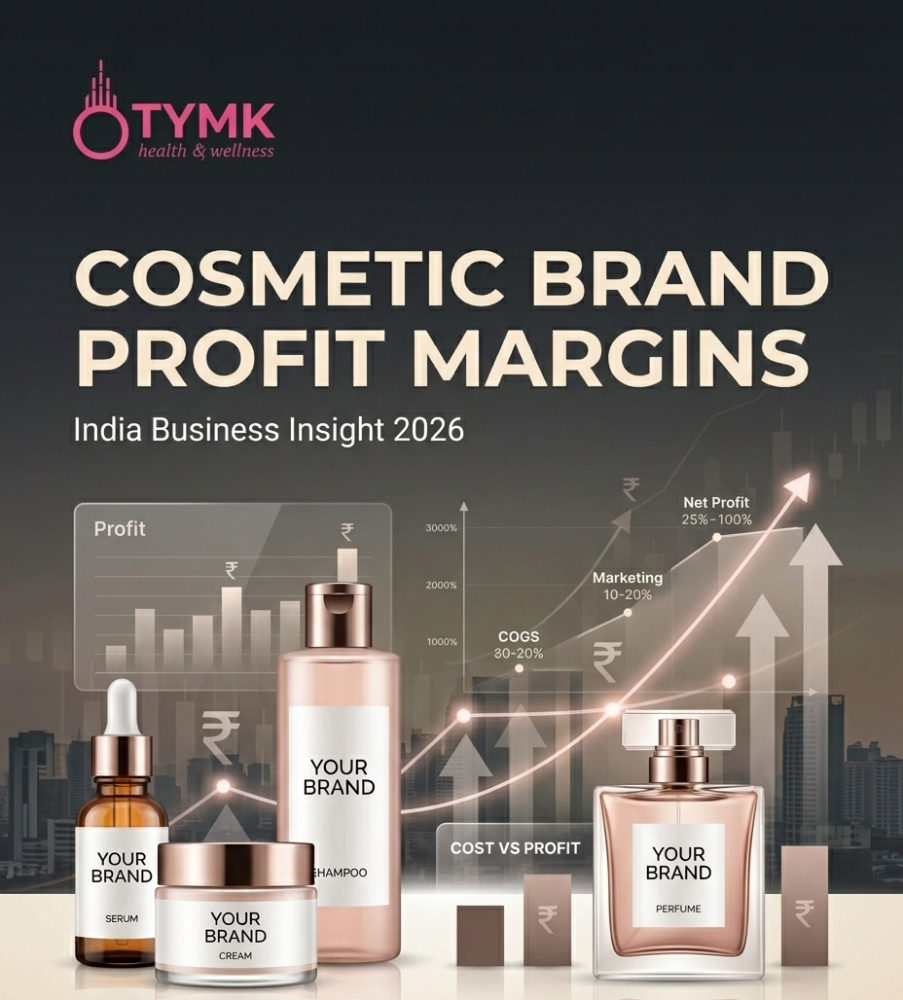
Cosmetic brand profit margins in India usually range between 25% to 65% depending on manufacturing model, packaging, branding, and marketing costs. Brands working with private label or white label cosmetic manufacturers like TYMK Group often improve margins faster because production, formulation, and scaling become more cost-efficient.
Why is Profit Margin Important in the Cosmetic Business?
A cosmetic business with poor margins struggles to survive long-term.
Even if sales increase, low profitability creates cash flow pressure.
Real-world example
A startup shampoo brand selling on marketplaces may generate ₹5 lakh monthly sales. But after:
- Marketplace commission
- Paid ads
- Packaging
- Returns
- GST
- Logistics
…the actual retained profit may drop below 12%.
This is why smart cosmetic founders focus on manufacturing efficiency first.
Real Cosmetic Product Cost Breakdown
Here’s a simplified breakdown of a skincare product sold online in India.
| Expense Type |
Estimated Cost |
| Product Manufacturing |
₹70 |
| Bottle & Packaging |
₹40 |
| Label Printing |
₹10 |
| Shipping |
₹35 |
| Influencer Marketing |
₹90 |
| Marketplace Commission |
₹60 |
| Miscellaneous |
₹20 |
| Total Cost |
₹325 |
| Selling Price |
₹599 |
| Approx Profit |
₹274 |
Now here’s where experienced brands gain an advantage:
They reduce production costs through:
- TYMK Group partnerships
- Bulk manufacturing
- OEM production
- White label systems
- Better supplier negotiation
How Does Cosmetic Manufacturing Work?
1. Private Label Manufacturing
A manufacturer creates ready-made products that brands sell under their own logo.
Popular related searches:
- White Label Cosmetic Manufacturer
- Herbal Products Private Label Manufacturer
- Perfume Private Label Manufacturer
- Baby Care Products Private Label Manufacturer
- Nutraceutical Products Private Label Manufacturer
This model is ideal for startups because development costs stay lower.
2. White Label Manufacturing
White label means multiple brands can use similar formulations with custom branding.
Common examples include:
- Skin Care Products White Label Manufacturer
- Hair Care Products White Label Manufacturer
- Ayurvedic Products White Label Manufacturer
- Toothpaste White Label Manufacturer
This model reduces launch time significantly.
3. OEM Manufacturing
OEM stands for Original Equipment Manufacturing.
The manufacturer creates products based on your custom formula or requirements.
Examples:
- OEM Herbal Products
- OEM Shampoo Manufacturer
- OEM Face Serum
- OEM Nutraceuticals Products
OEM usually provides better brand uniqueness but requires higher investment.
4. Contract Manufacturing
In contract manufacturing, the production partner handles large-scale manufacturing processes.
Common searches include:
- Hair care products Contract Manufacturer
- Perfume Contract Manufacturer
- Food supplements products Contract Manufacturer
- PET care products Contract Manufacturer
This model works well for scaling brands.
Profit Margin Comparison by Category
| Product Category |
Average Gross Margin |
| Skincare |
45%–70% |
| Haircare |
35%–60% |
| Perfumes |
40%–75% |
| Herbal Supplements |
30%–55% |
| Baby Care |
35%–60% |
| Colour Cosmetics |
50%–80% |
| MLM Products |
25%–50% |
| Pet Care Products |
30%–55% |
Premium positioning usually increases margins faster than discount pricing.
Real Business Insight: Small Brand vs Smart Brand
A Gujarat-based skincare startup launched with premium glass packaging, expensive influencers, and custom formulations.
Initial investment crossed ₹18 lakh.
Margins became unstable because marketing expenses were too high.
Another founder used:
- White label manufacturing
- Smaller MOQ
- Controlled packaging costs
- Direct Instagram selling
That brand became profitable within 8 months.
In real-world terms, cosmetic profitability depends less on “viral branding” and more on operational control.
When Should You Choose Private Label Manufacturing?
Private label manufacturing works best if:
- You are launching a new cosmetic brand
- You want faster market entry
- The budget is limited
- You need lower R&D costs
- You want scalable production
This is why searches like:
- Shampoo Private Label Manufacturer
- Colour Cosmetics Products Private Label Manufacturer
- Healthcare Products Private Label Manufacturer
continue growing rapidly in India.
Who Should Start a Cosmetic Brand?
Best suited for:
| Business Type |
Why It Works |
| Influencers |
Existing audience trust |
| Salon Owners |
Ready customer base |
| Ayurveda Startups |
Rising herbal demand |
| MLM Companies |
Repeat purchase model |
| D2C Founders |
High online growth potential |
| Pharma Distributors |
Manufacturing network advantage |
Which Manufacturing Option is Best?
| Manufacturing Type |
Best For |
Investment Level |
| Private Label |
Beginners |
Low |
| White Label |
Fast Launch |
Low-Medium |
| OEM |
Unique Brand Building |
High |
| Contract Manufacturing |
Scaling Brands |
Medium-High |
Most startups begin with a private label and shift toward OEM later.
Choosing the right manufacturing partner directly impacts your profit margin.
TYMK Group works across multiple categories, including:
- White Label Cosmetic Manufacturer
- MLM Product Manufacturer
- Perfume Contract Manufacturer
- Hair Care Products Manufacturer
- Baby Care Products Manufacturer
- Nutraceutical Products White Label Manufacturer
- PET Care Products Private Label Manufacturer
What makes the company different is the wide product range, private label support, OEM solutions, and category diversification under one ecosystem.
For growing brands, this reduces sourcing complexity and operational delays.
Common Mistakes That Destroy Cosmetic Profits
1. Overspending on Packaging
Premium packaging helps branding, but high costs reduce margins quickly.
2. Ignoring MOQ Strategy
Large inventory without demand validation creates dead stock.
3. Choosing Cheap Manufacturers
Low-cost production often leads to quality complaints and customer churn.
4. Overdependence on Paid Ads
Many brands spend 40–60% revenue on advertising alone.
5. Wrong Pricing Strategy
Underpricing products damages long-term scalability.
FAQs
What is the average profit margin in the cosmetic business?
The average cosmetic business margin in India ranges between 25% to 65%, depending on manufacturing type, product category, and marketing expenses.
Which manufacturing model is best for beginners?
Private label manufacturing is usually best for beginners because it reduces development costs and speeds up product launches.
Is white-label cosmetic manufacturing profitable?
Yes. White-label systems can improve profitability because brands avoid heavy R&D investment while launching faster.
How do cosmetic brands reduce manufacturing costs?
Brands reduce costs through bulk ordering, better packaging control, OEM production, and partnerships with manufacturers like TYMK Group.
Which cosmetic category has the highest margins?
Colour cosmetics, perfumes, and premium skincare products generally offer higher profit margins.
Is starting a cosmetic brand in India worth it?
Yes. India’s beauty and personal care market continues to grow rapidly, especially in D2C, herbal, Ayurvedic, and premium skincare segments.
For industry statistics and cosmetic regulations, refer to:
Conclusion
The cosmetic industry in India offers strong business potential, but profitability depends on smart manufacturing decisions, controlled branding costs, and scalable operations.
Most successful brands today are not necessarily the ones spending the most on advertising. They are the ones building better supply chains, stronger manufacturing partnerships, and healthier margins from day one.
Whether you are exploring:
- OEM Herbal Products
- Shampoo Manufacturer
- Face Serum Contract Manufacturer
- Colour Cosmetics Products Manufacturer
- Nutraceutical Products Private Label Manufacturer
…the right manufacturing strategy can significantly change your business growth trajectory.
To explore manufacturing solutions and product development opportunities, visit TYMK Group.