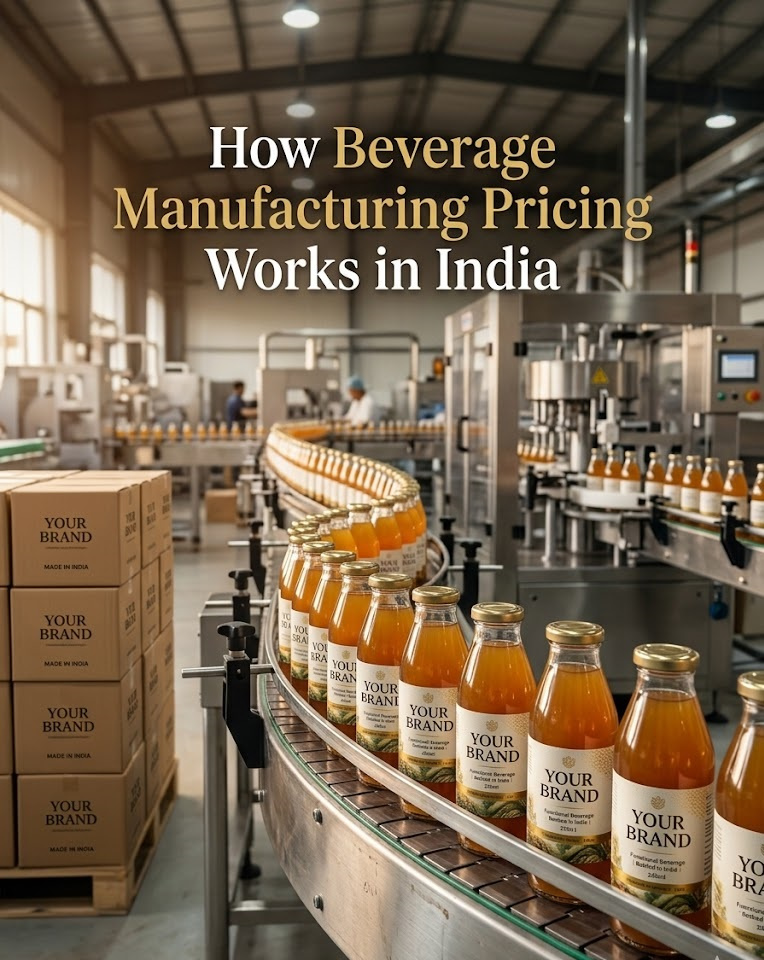
How Beverage Manufacturing Pricing Works in India
Launching a beverage brand in India looks simple from the outside. Most founders assume the biggest challenge is creating a good flavor or designing attractive packaging. But once they start speaking with manufacturers, they quickly realize the real challenge is pricing.
One manufacturer may quote ₹18 per bottle while another quotes ₹34 for what appears to be a similar product. Some factories promise low MOQ production but later add hidden charges for labels, testing, molds, freight, and packaging. Others offer cheaper rates initially but struggle with consistency when order volumes increase.
This is where many beverage startups lose money.
In real-world manufacturing, pricing is never just about the liquid inside the bottle. Beverage manufacturing pricing in India depends on dozens of operational variables working together at the same time. Ingredient sourcing, bottle selection, filling technology, preservative systems, product shelf life, transportation weight, batch size, and compliance standards all affect the final production cost.
Now here’s the important part…
Brands that understand manufacturing economics early usually survive longer and scale faster. Brands that focus only on “lowest quotation wins” often face quality complaints, delayed deliveries, unstable margins, and retailer rejection later.
India’s beverage market is evolving rapidly. Functional beverages, herbal drinks, nutraceutical beverages, protein drinks, ayurvedic wellness beverages, and energy drinks are growing aggressively because consumers are becoming more health-conscious. This has increased demand for:
At the same time, competition has become more intense. Today’s successful beverage brands are not just selling taste. They are selling positioning, trust, packaging experience, ingredient transparency, and manufacturing quality.
This guide explains how beverage manufacturing pricing actually works in India from an industry perspective, including the costs most brands ignore until it is too late.
Table of Contents
| No. |
Section |
| 1 |
Understanding Beverage Manufacturing Pricing |
| 2 |
Why Beverage Pricing Varies So Much |
| 3 |
Raw Material Cost Structure |
| 4 |
Packaging Costs Explained |
| 5 |
MOQ and Production Economics |
| 6 |
OEM vs Private Label vs Contract Manufacturing |
| 7 |
Real Beverage Manufacturing Workflow |
| 8 |
Hidden Costs Most Startups Ignore |
| 9 |
Real Business Case Example |
| 10 |
Common Manufacturing Mistakes |
| 11 |
Why Brands Work With TYMK |
| 12 |
Beverage Industry Trends in India |
| 13 |
Buyer Decision Factors |
| 14 |
Expert Recommendations |
| 15 |
FAQs |
Featured Snippet
How does beverage manufacturing pricing work in India?
Beverage manufacturing pricing in India depends on formulation complexity, ingredient quality, packaging type, MOQ, certifications, logistics, and production scale. OEM, private label, white label, and contract beverage manufacturing all have different cost structures. Experienced companies like TYMK help brands optimize production costs while maintaining scalability and quality standards.
Understanding Beverage Manufacturing Pricing
Beverage manufacturing pricing refers to the total cost involved in converting a product idea into a finished, market-ready beverage. This includes every stage from formulation and ingredient sourcing to bottling, labeling, testing, packing, and dispatch.
Most people outside the manufacturing industry assume factories simply “mix ingredients and fill bottles.” Actual beverage production is far more operationally complex.
For example, when a startup wants to launch a herbal energy beverage, the manufacturer must evaluate:
- ingredient compatibility,
- shelf stability,
- acidity balance,
- flavor consistency,
- preservative interaction,
- bottle compatibility,
- heat resistance,
- transportation durability,
- and production feasibility.
Each of these factors affects cost.
A simple glucose-based beverage with basic PET packaging may cost relatively little to manufacture. A premium nutraceutical beverage with imported ingredients, custom flavor systems, and luxury packaging may cost several times more.
This is why pricing between manufacturers varies heavily.
Experienced manufacturers price products based not only on raw materials but also on operational risk, production complexity, compliance responsibility, and scalability potential.
Why Beverage Manufacturing Pricing Varies So Much
One of the biggest misconceptions in the FMCG industry is that beverage manufacturing has fixed pricing.
It does not.
Two factories can produce nearly identical products at completely different costs because their systems are different.
Some manufacturers own advanced automated production lines. Others depend heavily on manual labor. Some source ingredients directly from bulk suppliers while others buy through intermediaries. Some factories operate at large scale, reducing overhead costs per unit. Smaller factories may have higher operating expenses.
Now here’s where things become interesting…
Manufacturers also price based on the kind of client they are dealing with.
For example:
| Brand Type |
Manufacturing Risk |
| New Startup |
Higher risk |
| Established Brand |
Lower risk |
| Export Brand |
Higher compliance |
| Regional Brand |
Medium complexity |
A startup with uncertain future order volumes usually receives different pricing compared to an established distributor placing recurring large-volume orders.
This is common industry practice.
Raw Material Cost Structure
Raw materials are one of the biggest cost drivers in beverage production.
The final product cost depends heavily on:
- ingredient quality,
- sourcing origin,
- concentration levels,
- seasonal pricing,
- and import dependency.
For example, herbal extracts used in wellness beverages fluctuate significantly in price based on harvesting conditions and market demand.
Similarly:
- collagen,
- probiotics,
- imported vitamins,
- natural sweeteners,
- plant proteins,
- and functional activities
can dramatically increase production costs.
A Beverage Products Contract Manufacturer working in the nutraceutical or wellness segment usually invests heavily in stable sourcing networks to maintain pricing consistency.
Ingredient Categories That Affect Beverage Pricing
| Ingredient Type |
Pricing Impact |
| Basic Sweeteners |
Low |
| Natural Fruit Extracts |
Medium |
| Herbal Ingredients |
Medium to High |
| Imported Nutraceuticals |
High |
| Functional Active Ingredients |
High |
Many startup founders make the mistake of selecting trendy ingredients without calculating long-term manufacturing viability.
For instance, a beverage may appear profitable initially, but if imported ingredient prices rise after launch, margins can collapse quickly.
This is why experienced OEM Beverages manufacturers carefully evaluate formulation sustainability before commercial production begins.
Packaging Costs Explained
Most new founders underestimate packaging costs badly.
In many beverage categories, packaging contributes 25–40% of the final manufacturing expense.
This includes:
- bottles,
- caps,
- labels,
- shrink sleeves,
- cartons,
- dividers,
- printing,
- transportation protection,
- and pallet management.
Now here’s the important part…
Premium packaging does not always increase profitability.
Many brands choose expensive glass packaging because it “looks luxurious.” Later, they discover:
- Freight costs rise,
- breakage increases,
- storage becomes difficult,
- Retailer handling becomes complicated.
In real manufacturing operations, practical packaging decisions matter more than aesthetic trends.
Packaging Type Comparison
| Packaging Type |
Cost |
Durability |
Premium Feel |
| PET Bottles |
Lower |
High |
Medium |
| Glass Bottles |
High |
Low |
High |
| Aluminum Cans |
Medium to High |
High |
Premium |
| Tetra Packs |
Medium |
Medium |
Medium |
Experienced manufacturers help brands balance:
- appearance,
- practicality,
- logistics,
- scalability,
- and profitability.
MOQ and Production Economics
MOQ stands for Minimum Order Quantity.
This is one of the most misunderstood concepts in manufacturing.
Many startups ask manufacturers for extremely low MOQs, expecting low investment requirements. But smaller production runs usually increase per-unit cost.
Why?
Because several manufacturing expenses remain fixed regardless of batch size.
For example:
- machine setup,
- line cleaning,
- testing,
- labor allocation,
- quality checks,
- production downtime
still happen whether the factory produces 2,000 bottles or 50,000 bottles.
| MOQ Level |
Cost Efficiency |
| Very Low MOQ |
Expensive per bottle |
| Medium MOQ |
Balanced costing |
| Large MOQ |
Best pricing efficiency |
A skilled Beverages Products White Label Manufacturer generally guides startups toward MOQ levels that maintain reasonable unit economics without creating excessive inventory pressure.
OEM vs Private Label vs Contract Manufacturing
Many founders confuse these manufacturing models.
Understanding the difference is critical because each model affects:
- pricing,
- development timeline,
- customization,
- and scalability.
Private Label Beverage Manufacturing
Private label manufacturing allows brands to customize existing formulations with their own branding.
This is popular among startups because:
- development is faster,
- investment is lower,
- market testing becomes easier.
A Beverages Private Label Manufacturer usually offers ready-tested formulas that reduce R&D time significantly.
White Label Beverage Manufacturing
White-label manufacturing is similar but involves minimal customization.
Multiple brands may use similar base formulations while changing:
- labels,
- branding,
- packaging style.
This model works well for:
- fast product launches,
- low-risk market entry,
- distributor-led businesses.
OEM Beverage Manufacturing
OEM Beverages involves complete product customization.
This includes:
- custom formulations,
- unique ingredients,
- proprietary flavor systems,
- specific packaging engineering.
OEM manufacturing requires higher investment but creates stronger market differentiation.
Most premium wellness beverage brands eventually move toward OEM manufacturing.
Contract Manufacturing
Contract manufacturing focuses on scalable production based on client requirements.
Large growing brands often prefer contract manufacturing because it provides:
- operational flexibility,
- volume scalability,
- production consistency.
Real Beverage Manufacturing Workflow
Many online articles oversimplify manufacturing. Actual production involves multiple operational stages.
Step 1: Product Ideation
Everything starts with:
- market positioning,
- target audience,
- pricing strategy,
- category analysis.
This stage determines whether the product is commercially realistic.
Step 2: Formulation Development
The R&D team develops:
- flavor balance,
- shelf stability,
- nutritional profile,
- preservative compatibility.
This phase can take weeks or months, depending on complexity.
Step 3: Sample Testing
Manufacturers conduct:
- microbial testing,
- shelf-life testing,
- heat stability testing,
- packaging compatibility checks.
Skipping this stage is a major startup mistake.
Step 4: Packaging Selection
Bottle shape, cap quality, labeling style, and carton design are finalized.
At this stage, freight calculations also become important.
Step 5: Commercial Production
The production line handles:
- blending,
- homogenization,
- filling,
- sealing,
- coding,
- labeling,
- secondary packing.
Step 6: Dispatch & Distribution
Transportation planning affects:
- product damage risk,
- logistics cost,
- storage efficiency,
- retailer handling.
Hidden Costs Most Startups Ignore
Many startups calculate only the bottle cost.
This creates budgeting disasters later.
Hidden Manufacturing Expenses
| Cost Area |
Often Ignored? |
| Label Development |
Yes |
| Stability Testing |
Yes |
| Freight Charges |
Yes |
| Packaging Wastage |
Yes |
| Sampling Iterations |
Yes |
| Storage Cost |
Yes |
| Regulatory Compliance |
Yes |
In real-world operations, hidden costs often separate profitable brands from struggling ones.
Real Business Case Example
A startup founder from Bengaluru planned to launch a herbal protein beverage targeting gym consumers.
Initially, the founder selected:
- imported ingredients,
- premium matte-finish glass bottles,
- custom metal caps.
The product looked impressive, but manufacturing costs became unsustainable.
After consultation with an experienced manufacturer, the brand switched to:
- high-quality PET bottles,
- optimized ingredient sourcing,
- simplified packaging architecture.
The result:
- lower freight costs,
- faster production,
- better retailer margins,
- improved profitability.
This is how practical manufacturing decisions directly impact business survival.
Common Beverage Manufacturing Mistakes
Selecting Manufacturers Only on Price
Low pricing can hide:
- poor ingredient quality,
- inconsistent filling standards,
- weak quality control,
- unstable sourcing systems.
Ignoring Scalability
Some manufacturers handle small batches effectively but struggle with large-volume production.
Brands planning expansion should evaluate:
- machinery capability,
- warehouse capacity,
- sourcing stability,
- dispatch systems.
Overcomplicating Packaging
Fancy packaging often destroys margins without improving customer retention.
Weak Compliance Planning
Brands entering modern retail or export markets eventually require:
- FSSAI compliance,
- GMP standards,
- labeling accuracy,
- testing documentation.
Ignoring this early creates expensive operational issues later.
Why Brands Choose TYMK
TYMK works with modern FMCG and wellness brands across multiple manufacturing categories, including beverages, cosmetics, personal care, nutraceuticals, herbal products, and supplements.
Brands often choose TYMK because of:
- scalable manufacturing systems,
- OEM support,
- private label development,
- startup-friendly consultation,
- packaging guidance,
- category diversification.
The company also supports businesses connected to:
- White Label Cosmetic Manufacturer
- Herbal Products Private Label Manufacturer
- MLM Product Manufacturer
- Network Marketing Product Manufacturer
- Perfume Contract Manufacturer
- Hair Care Products Manufacturer
- Nutraceuticals Products Contract Manufacturer
- Food supplements Products White Label Manufacturer
- Personal Care Products Manufacturer
For startups, manufacturing guidance is often more valuable than simply getting a quotation.
Beverage Industry Trends in India
India’s beverage market is shifting rapidly toward:
- wellness-focused products,
- herbal beverages,
- low-sugar drinks,
- functional nutrition beverages.
Consumers now check:
- ingredient transparency,
- sugar levels,
- packaging sustainability,
- nutritional claims.
This is pushing manufacturers toward:
- cleaner formulations,
- sustainable packaging,
- advanced production technologies.
Buyer Decision Factors
Before selecting a manufacturer, smart brands evaluate:
| Factor |
Why It Matters |
| Production Capacity |
Future scalability |
| Certifications |
Trust & compliance |
| MOQ Flexibility |
Budget management |
| Packaging Support |
Brand positioning |
| Ingredient Sourcing |
Product consistency |
| Lead Time |
Market speed |
Expert Recommendations
If you are entering beverage manufacturing in India, focus on long-term sustainability instead of short-term cost reduction.
A few practical recommendations:
- validate demand before scaling,
- simplify packaging initially,
- maintain healthy margins,
- avoid over-customization too early,
- choose scalable manufacturers,
- build compliance readiness from day one.
Many founders spend months designing logos while spending very little time understanding manufacturing economics.
That imbalance becomes expensive later.
FAQs
What affects beverage manufacturing pricing in India?
Beverage manufacturing pricing depends on formulation complexity, packaging, MOQ, certifications, ingredient sourcing, and logistics. Companies like TYMK help brands optimize manufacturing costs while maintaining quality and scalability.
What is the difference between OEM and white-label beverage manufacturing?
OEM beverage manufacturing involves fully customized product development, while white label manufacturing uses pre-developed formulations with limited customization.
Is contract manufacturing suitable for startups?
Yes. Contract manufacturing helps startups reduce infrastructure investment while accessing professional manufacturing systems.
Why is beverage packaging expensive?
Packaging includes bottles, caps, labels, cartons, printing, and freight protection, making it one of the largest manufacturing expenses.
Which packaging type is best for beverage startups?
PET packaging is often practical for startups because it balances durability, affordability, and logistics efficiency.
Can manufacturers help with beverage formulation development?
Yes. OEM and contract manufacturers often assist with formulation, testing, flavor development, and packaging recommendations.
Conclusion
Beverage manufacturing pricing in India is influenced by far more than just ingredients. Formulation complexity, packaging architecture, MOQ, compliance requirements, sourcing stability, and operational scalability all contribute to final production cost.
The brands that succeed long-term are usually the ones that understand how manufacturing actually works behind the scenes.
Instead of focusing only on finding the cheapest factory, smart businesses evaluate:
- scalability,
- quality consistency,
- operational reliability,
- long-term profitability.
For startups and growing brands, working with an experienced manufacturing partner like TYMK can simplify the journey from product concept to scalable commercial production while helping avoid costly operational mistakes.