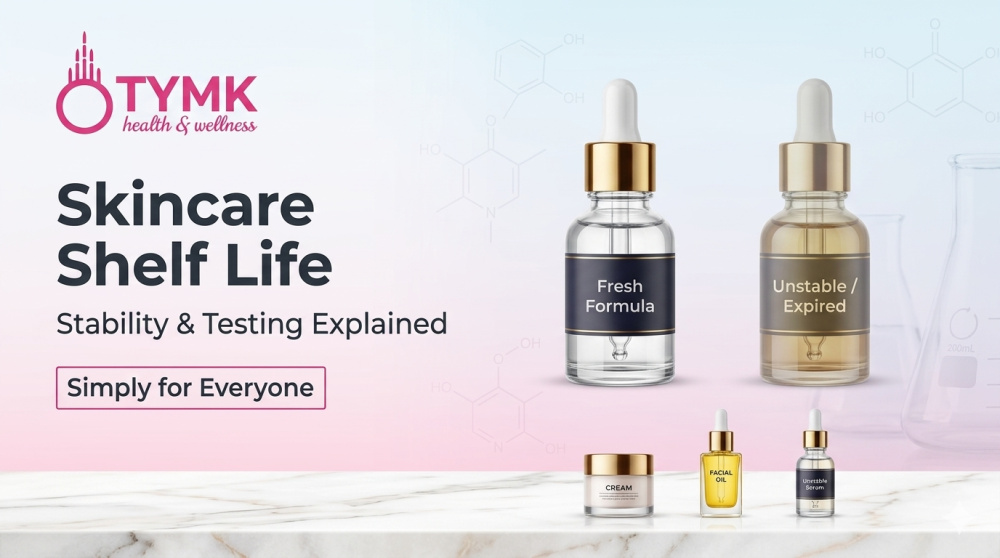
Skincare Shelf Life, Stability & Testing Explained Simply
Understand skincare shelf life, stability testing, and how manufacturers ensure product safety, performance, and long-term formulation quality.
Table of Contents
- Introduction
- What shelf life and stability actually mean in skincare
- Why stability testing matters more than most brands realize
- How stability testing is actually done in labs
- When this testing becomes non-negotiable
- Who depends on it the most
- Manufacturing models and how they differ
- Real product failure example
- How TYMK approaches formulation stability
- FAQ
- Final takeaway
Introduction
Skincare looks simple from the outside. A cream, a serum, a face wash—same shelf, same packaging, same claims.
But inside the industry, there is a quiet problem most people never see.
A product can look stable and still break down chemically long before its expiry date.
Texture changes. Active ingredients lose strength. Natural extracts oxidize faster than expected.
And by the time customers notice it, the damage is already done.
That is exactly where skincare product shelf life, stability & testing become the deciding factor between a reliable brand and a failed launch.
What shelf life and stability actually mean in skincare
Shelf life is not just a printed expiry date.
It is the real-world time period during which a product:
- stays physically unchanged
- keeps its chemical strength
- remains microbiologically safe
Stability testing is the process that checks all of this under stress conditions like heat, humidity, and light exposure.
Shelf Life=Period where formulation remains chemically + physically stable under real storage conditions\text{Shelf Life} = \text{Period where formulation remains chemically + physically stable under real storage conditions}Shelf Life=Period where formulation remains chemically + physically stable under real storage conditions
In simple terms, this is how brands find out if a product survives outside the lab.
Why stability testing matters more than most brands realize
Most early-stage skincare brands focus on branding, packaging, or marketing.
Stability testing usually feels like a “technical step in the background.”
But in reality, it decides three critical things:
- whether the product stays effective in hot climates
- whether ingredients stay active till the end of use
- whether customers trust the brand after the first batch
In India, especially, temperature shifts and humidity changes make instability a very real issue. A formula that behaves perfectly in a controlled lab can behave differently in retail storage or shipping conditions.
That gap is where most failures happen.
How stability testing actually works (in real labs)
The process is more practical than it sounds.
A small batch is created and then pushed through different stress environments:
- high temperature chambers
- humidity exposure
- light exposure tests
- long-term room temperature storage
Over time, technicians observe changes like:
- color shift
- odor changes
- separation of oil and water phases
- pH drift
- microbial growth
It is less “theory” and more observation under pressure.
If something breaks early, formulation goes back to the lab for adjustment.
When stability testing becomes non-negotiable
There are moments when skipping this step is not an option:
- before the first commercial launch
- when switching packaging materials
- when scaling from a lab batch to factory production
- when changing preservative systems
- when launching in multiple climates
Many products pass small-batch testing but fail at scale. That mismatch is common in cosmetic manufacturing.
Who actually depends on this process
Stability testing is not just for scientists.
It directly affects:
- skincare brands launching new products
- OEM and third-party manufacturers
- private label cosmetic businesses
- herbal and Ayurvedic product companies
- nutraceutical and personal care brands
Any business producing formulations at scale depends on it—whether they realize it or not.
Manufacturing models behave differently
Different production models handle stability in different ways:
White label
Pre-developed formulas, already tested. Faster entry, less flexibility.
Private label
Custom formulations. Stability testing becomes part of product identity.
OEM / contract manufacturing
Full responsibility on manufacturer's side. Testing, compliance, production—all integrated.
In real market conditions, private label and OEM models dominate because they allow branding flexibility with controlled formulation ownership.
Real-world failure example
A skincare startup launched a vitamin C serum with strong early reviews.
But within 60–90 days, customers started reporting:
- color darkening
- reduced effectiveness
- uneven texture
What happened wasn’t a marketing failure.
It was oxidation—slow and predictable, but not properly tested for long storage conditions.
The batch had passed basic checks but failed the long-term stability simulation.
Reformulation became necessary, and the relaunch cost significantly more than the original development.
How TYMK approaches formulation stability
In manufacturing systems like TYMK, stability is not treated as a final step—it is built into development from the beginning.
The focus is not just “making a product,” but making sure it survives:
- temperature variation
- packaging changes
- supply chain delays
- long retail cycles
This approach reduces downstream failure risk and improves consistency across batches.
More details can be explored at https://tymk.world/
Key Summary Table: Skincare Shelf Life & Stability Testing
| Section |
Core Insight |
Practical Meaning in Industry |
| Shelf Life Definition |
The time a product remains safe, stable, and effective |
Determines expiry beyond the printed date |
| Stability Testing |
Evaluation of formulation under stress conditions |
Simulates real-world storage and usage |
| Importance |
Prevents degradation, contamination, and failure |
Protects brand trust and product performance |
| Testing Methods |
Heat, humidity, light, and long-term storage tests |
Detects early chemical or physical changes |
| Critical Timing |
Before launch, scale-up, or packaging change |
Avoids batch failure in mass production |
| Who Needs It |
Brands, OEM, private label, and herbal manufacturers |
Essential for all cosmetic production models |
| Manufacturing Models |
White label, private label, OEM |
Different levels of control & responsibility |
| Real Risk Scenario |
Oxidation or texture breakdown after launch |
Leads to returns, complaints, reformulation |
| Industry Practice |
Stability integrated into formulation stage |
Reduces long-term product failure risk |
| Regulatory Reference |
CDSCO guidelines (India) |
Ensures compliance with cosmetic safety standards |
(regulatory standard)
For official cosmetic manufacturing and safety guidelines, regulatory standards are defined by:
https://cdsco.gov.in
(Central Drugs Standard Control Organization – India)
Skincare shelf life refers to the time period during which a cosmetic product remains stable, safe, and effective. It is determined through stability testing, which evaluates how formulation changes under heat, humidity, and storage conditions before market release.
FAQs
What is skincare shelf life?
It is the time a product remains stable and effective under recommended storage conditions.
Why is stability testing needed?
It ensures product safety, ingredient performance, and long-term formulation integrity.
How long does testing take?
Usually between 1–6 months, depending on testing type and formulation complexity.
Can a product fail after passing lab tests?
Yes. Some formulas behave differently at scale or under real storage conditions.
Is stability testing mandatory?
For regulated cosmetic manufacturing, it is a standard requirement.
Final takeaway
Skincare stability is not a technical formality—it is the point where formulation meets reality.
A product is only as strong as its ability to survive time, temperature, and distribution.
Brands that ignore this usually discover the problem after customers do.