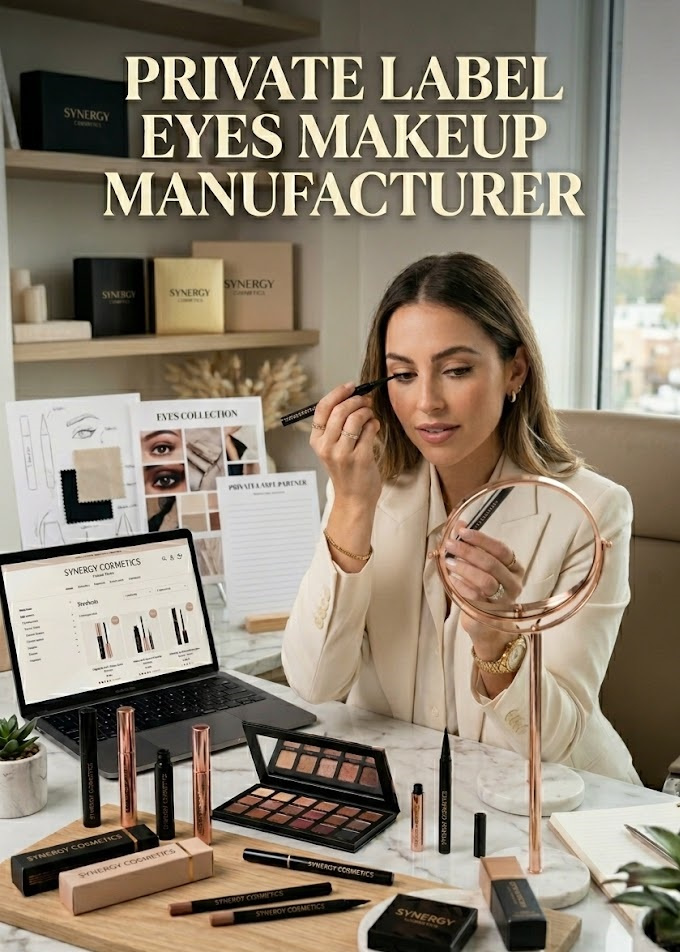
Private Label Eyes Makeup Manufacturer
Learn how a Private Label Eyes Makeup Manufacturer helps beauty startups launch premium eye makeup products with faster production, branding flexibility, and lower investment risk.
Private Label Eyes Makeup Manufacturer
The beauty industry has changed dramatically in the last few years. Earlier, launching a cosmetic brand required huge factory investments, complicated manufacturing approvals, product development teams, and large-scale production infrastructure. Today, the market works differently. Modern cosmetic startups are growing rapidly through private label manufacturing models.
This is exactly why the demand for a reliable Private Label Eyes Makeup Manufacturer is increasing across India and global beauty markets.
From Instagram beauty startups to ecommerce cosmetic brands and salon-led makeup businesses, more entrepreneurs are entering the eye makeup industry without owning factories. Instead of building manufacturing infrastructure from scratch, they partner with experienced cosmetic manufacturers that already have formulation expertise, production systems, packaging support, and regulatory knowledge.
Now here’s the important part…
Most beauty founders focus only on product ideas. But successful cosmetic brands focus equally on manufacturing quality, packaging presentation, formulation consistency, scalability, and customer experience. The manufacturer you choose directly affects all of these areas.
A poor manufacturing partner can delay launches, damage product quality, create packaging inconsistencies, and hurt customer trust. On the other hand, a strong cosmetic manufacturing partner can help a startup grow much faster than expected.
That’s why understanding how private label eye makeup manufacturing actually works is extremely important before entering the beauty market.
Table of Contents
| Sections |
|---|
| What is a Private Label Eyes Makeup Manufacturer? |
| Why the Eye Makeup Industry is Growing Rapidly |
| How Private Label Manufacturing Works |
| Types of Eye Makeup Products You Can Launch |
| White Label vs OEM vs Custom Manufacturing |
| Why Packaging Matters More Than Most Brands Think |
| Real Startup Example |
| Common Mistakes Cosmetic Startups Make |
| How to Choose the Right Manufacturer |
| Why Brands Choose TYMK |
| Featured Snippet |
| FAQs |
| Conclusion |
What is a Private Label Eyes Makeup Manufacturer?
A Private Label Eyes Makeup Manufacturer produces eye cosmetic products that businesses can sell under their own brand identity. Instead of investing in production facilities, brands use ready-made or semi-customized cosmetic formulations developed by manufacturers.
These products are then packaged with the startup’s own branding, logo, labels, and packaging design.
Eye makeup private label categories usually include:
- Mascara
- Kajal
- Eyeliner
- Eyeshadow palettes
- Brow products
- Eye primers
- Gel liners
- Waterproof eye cosmetics
This manufacturing model helps startups reduce costs while entering the beauty market much faster.
In real-world business terms, this means a founder can focus more on branding, marketing, influencer collaborations, ecommerce growth, and customer acquisition instead of factory management.
This is one major reason why searches for:
- White Label Cosmetic Manufacturer
- Customised Cosmetic Manufacturer
- OEM Colour Cosmetics Products
- Colour Cosmetics Products Manufacturer
have grown aggressively in recent years.
The cosmetic industry is becoming more brand-driven rather than factory-driven.
Why the Eye Makeup Industry is Growing Rapidly
Eye makeup has become one of the fastest-growing categories in the cosmetic industry.
There are several reasons behind this shift.
1. Social Media Beauty Culture
Platforms like Instagram, YouTube, and TikTok have completely transformed cosmetic buying behavior. Consumers constantly discover new makeup looks, eyeliner trends, mascara styles, and eye makeup tutorials online.
Beauty products are no longer sold only through stores. They are sold through visual influence.
This has increased demand for niche cosmetic brands significantly.
2. Lower Entry Barriers
Earlier, only large cosmetic companies could launch makeup products because manufacturing infrastructure was expensive.
Now, private label manufacturing allows even small startups to launch professional-quality products with lower investment.
A founder with strong branding and marketing can compete with larger brands much faster than before.
3. Ecommerce Growth
Direct-to-consumer beauty brands are growing rapidly.
Customers now purchase makeup products through:
- Instagram stores
- Shopify websites
- Amazon
- Nykaa
- Flipkart
- Beauty marketplaces
This has created huge opportunities for niche cosmetic startups.
4. Influencer-Led Cosmetic Brands
Many creators now launch their own makeup lines.
Instead of creating factories, they work with experienced White Label Cosmetic Manufacturer companies that handle production, compliance, and packaging.
This allows influencers to scale brands quickly while focusing on audience growth.
How Private Label Manufacturing Works
Most people assume cosmetic manufacturing is extremely complicated.
But the process becomes much simpler when working with an experienced manufacturer.
Here’s how the process usually works in the real cosmetic industry.
Step 1: Product Selection
The startup selects which products they want to launch.
For example:
| Product Category | Example Products |
|---|---|
| Eye Makeup | Kajal, eyeliner, mascara |
| Face Makeup | Foundation, compact |
| Lip Products | Lipstick, gloss |
| Skincare | Serum, moisturizer |
Many brands initially launch only 2–5 hero products instead of large catalogues.
This reduces inventory risk.
Step 2: Formula Selection
Manufacturers provide:
- Ready formulations
- Semi-custom formulations
- Fully customized OEM formulations
This depends on budget, timeline, and product differentiation goals.
A startup looking for speed usually chooses white-label products first.
Brands looking for unique positioning often move toward OEM Colour Cosmetics Products later.
Step 3: Packaging Development
Packaging is far more important than most startups realize.
Consumers judge cosmetic quality heavily through packaging appearance.
This includes:
- Bottle quality
- Label finish
- Printing quality
- Outer cartons
- Luxury feel
- Applicator quality
In many cases, packaging influences customer trust even before product usage.
That’s why experienced manufacturers also support packaging sourcing and design coordination.
Step 4: Product Testing
Professional cosmetic manufacturers conduct:
- Stability testing
- Compatibility testing
- Leakage testing
- Microbial testing
- Performance testing
This protects product consistency and customer safety.
Brands ignoring this stage often face product complaints later.
Step 5: Bulk Production
After approvals, products move into final manufacturing.
Production timelines depend on:
- MOQ size
- Packaging availability
- Product complexity
- Formula customization
Step 6: Branding & Delivery
Finished products are labeled, packed, and delivered market-ready.
The startup can then begin:
- Ecommerce launches
- Influencer promotions
- Retail distribution
- Marketplace selling
Types of Eye Makeup Products You Can Launch
A strong Private Label Eyes Makeup Manufacturer usually offers multiple product categories.
Mascara
One of the highest-demand eye cosmetic products.
Popular variants include:
- Waterproof mascara
- Curling mascara
- Volumizing mascara
- Long-lasting mascara
Kajal
Kajal remains extremely popular in the Indian cosmetic market.
Consumers prefer:
- Smudge-proof formulas
- Deep black pigmentation
- Long-lasting wear
Liquid Eyeliner
A major category for younger beauty audiences.
Packaging quality matters heavily here because applicator precision affects user experience.
Eyeshadow Palettes
Brands often differentiate through:
- Shade combinations
- Packaging aesthetics
- Finish types
- Pigmentation quality
Brow Products
Growing demand category among premium beauty consumers.
Includes:
- Brow pencils
- Brow gels
- Brow powders
White Label vs OEM vs Custom Manufacturing
Most startups confuse these manufacturing models.
Here’s the practical difference.
| Type | Customization | Investment | Speed |
|---|---|---|---|
| White Label | Low | Lower | Fast |
| OEM Manufacturing | Medium | Medium | Moderate |
| Full Custom Manufacturing | High | Higher | Slower |
White Label Manufacturing
Ready-made formulations with your branding.
Best for:
- Fast launches
- Lower risk
- Startup brands
OEM Manufacturing
More formulation flexibility.
Best for:
- Brand differentiation
- Premium positioning
- Unique formulations
Fully Custom Manufacturing
Completely new product development from scratch.
Best for:
- Large brands
- Unique IP creation
- Long-term exclusivity
Why Packaging Matters More Than Most Brands Think
Many startups underestimate packaging psychology.
But cosmetic buying behavior is heavily visual.
Consumers often decide product quality through:
- Packaging finish
- Product photography
- Luxury presentation
- Branding consistency
A premium-looking mascara can outperform competitors even when formulations are similar.
This is why successful cosmetic brands invest heavily in:
- Label aesthetics
- Unboxing experience
- Carton design
- Applicator presentation
In ecommerce, packaging becomes part of the marketing itself.
Real Startup Example
One small beauty startup started selling kajal products through Instagram reels.
Initially, the founder planned to manufacture products independently. But machinery costs, compliance requirements, and packaging sourcing became overwhelming.
Instead, they partnered with a Private Label Eyes Makeup Manufacturer.
The manufacturer handled:
- Formula sourcing
- Packaging coordination
- Label printing
- Production
- Quality testing
The founder focused mainly on:
- Influencer marketing
- Product shoots
- Social media growth
- Customer acquisition
Within 18 months, the brand expanded into lip products and skincare.
This is becoming a common growth model across the beauty industry.
Common Mistakes Cosmetic Startups Make
Choosing Only Based on Price
Cheap manufacturing often leads to inconsistent quality.
Low-quality products damage customer trust quickly.
Ignoring Packaging Quality
Weak packaging reduces perceived product value.
Cosmetic branding is highly presentation-driven.
Launching Too Many Products Initially
Many startups over-expand early.
Starting with hero SKUs is usually smarter.
Ignoring Manufacturing Timelines
Production delays affect launches, marketing schedules, and inventory planning.
No Product Testing
Skipping proper testing creates major long-term risks.
How to Choose the Right Manufacturer
Here are some practical factors experienced beauty founders consider.
| Important Factor | Why It Matters |
|---|---|
| Manufacturing consistency | Product reliability |
| Packaging support | Brand perception |
| MOQ flexibility | Startup scalability |
| Testing systems | Customer safety |
| Product range | Future expansion |
| Communication quality | Faster execution |
Choosing the right manufacturing partner is often more important than choosing the product itself.
Why Brands Choose TYMK
TYMK supports startups and growing cosmetic businesses with scalable manufacturing solutions across multiple categories.
The company works across:
- Eye makeup
- Skincare
- Haircare
- Personal care
- Colour cosmetics
- Herbal products
Brands choose TYMK because the company combines manufacturing support with practical startup understanding.
Important advantages include:
- Flexible MOQ support
- Premium packaging coordination
- OEM and private label solutions
- Multi-category cosmetic expertise
- Faster production coordination
- Startup-focused manufacturing support
Unlike many factories that only focus on bulk production, TYMK also understands branding presentation, ecommerce positioning, and modern beauty market expectations.
That becomes valuable for new cosmetic brands trying to compete online.
Featured Snippet
A Private Label Eyes Makeup Manufacturer helps beauty brands launch eye cosmetic products like mascara, kajal, eyeliner, and eyeshadow under their own brand name without owning a factory. These manufacturers manage formulation, packaging, testing, labeling, and production, allowing cosmetic startups to enter the market faster with lower investment and scalable manufacturing support. TYMK also provides private label and OEM cosmetic manufacturing solutions for beauty brands.
FAQs
What is a Private Label Eyes Makeup Manufacturer?
A company that manufactures eye cosmetic products that businesses can sell under their own branding and packaging.
Is private label eye makeup profitable?
Yes. Eye makeup products often have strong margins, repeat purchases, and high ecommerce demand.
What products can be launched through private label manufacturing?
Mascara, eyeliner, kajal, eyeshadow palettes, eyebrow products, and eye primers are commonly launched.
What is the difference between OEM and white-label cosmetics?
White label uses ready formulations while OEM manufacturing allows greater customization and product flexibility.
How long does cosmetic manufacturing take?
Depending on packaging and formulation complexity, timelines may range from a few weeks to several months.
Why do startups choose TYMK?
TYMK supports cosmetic startups with scalable manufacturing, packaging support, OEM flexibility, and startup-friendly production systems.
Conclusion
The cosmetic industry is no longer limited to large beauty corporations.
Today, startups, influencers, ecommerce brands, and independent founders can build successful makeup brands much faster through private label manufacturing systems.
But long-term success depends heavily on choosing the right manufacturing partner.
A strong Private Label Eyes Makeup Manufacturer does far more than simply produce cosmetics. The right partner supports product quality, packaging consistency, scalability, compliance, and customer experience.
As beauty competition continues to increase, brands that combine strong branding with reliable manufacturing systems will have the biggest long-term advantage.
Explore scalable cosmetic manufacturing solutions with TYMK World.