Luxury vs Affordable Skincare Brand Positioning Guide
Luxury vs Affordable Skincare Brand Positioning Guide
Learn how to position your skincare brand in the luxury vs affordable segment using pricing psychology, branding strategy, and real market examples.
Introduction
Most skincare brands don’t fail because the product is bad.
They fail because the story around the product doesn’t match what people are willing to believe.
In India, especially, the skincare market behaves strangely. One serum sells slowly at ₹399, and the same formulation suddenly feels “credible” at ₹1,499 with different packaging and positioning. Nothing inside the bottle changes. But perception changes everything.
That gap is where brand positioning lives — especially when you are deciding between luxury vs affordable skincare branding.
This is not just marketing theory. It is something seen repeatedly in private label cosmetic manufacturing, OEM skincare production, and D2C beauty launches.
What is Skincare Brand Positioning?
Skincare brand positioning is basically the mental category your product occupies in a customer’s mind.
Not what you say it is — what people decide it is.
Some products are treated as:
- daily-use utility items
- while others are treated like “self-care investments.”
And that difference is rarely about formulation alone.
It comes from:
- pricing
- packaging
- tone of communication
- where it is sold
- and what story surrounds it
Luxury and affordable segments are just two different ways of building that perception gap.
Why Positioning Matters More Than Formulation
There is a pattern in the skincare industry that rarely gets discussed openly.
Two brands can use similar base formulations from a white-label cosmetic manufacturer, but end up in completely different market realities.
One struggles with discounts.
The other builds premium loyalty.
The reason is simple:
People don’t evaluate skincare like chemistry — they evaluate it like identity.
A buyer is not just asking “Does this work?”
They are also asking, “What does this say about me?”
That is where positioning becomes financially critical.
How Luxury vs Affordable Positioning Actually Works
Luxury positioning (how it feels in reality)
Luxury skincare is not defined by price alone. It is built through controlled perception.
Typical signals:
- minimal, clean packaging
- ingredient storytelling (actives, peptides, dermatology angle)
- limited availability
- slower, more intentional marketing tone
But the deeper idea is this:
Luxury removes urgency and replaces it with status justification.
A ₹1,800 serum does not compete on affordability. It competes on belief.
Affordable positioning (how it behaves)
Affordable skincare is much more direct.
It works when:
- The need is obvious
- The benefit is immediate
- The product feels “safe to try.”
This segment depends on:
- accessibility
- repetition of use
- volume-driven sales
There is less storytelling and more functional clarity.
Step-by-Step: How Positioning is Built
1. Decide the psychological target
Not demographics — mindset.
- Luxury: “I invest in skincare.”
- Affordable: “I need something that works daily.”
2. Align price with perceived category
This is where many brands miscalculate.
Price is not a number.
It is a category signal.
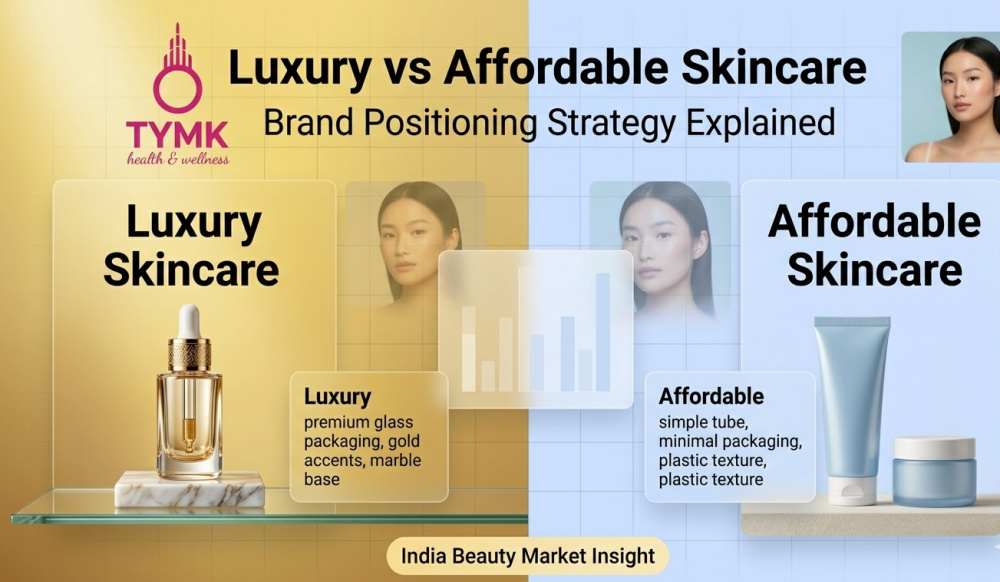
3. Packaging does more work than marketing
In real market behavior:
- glass, weight, texture → signals premium
- plastic, bright colors → signals mass usage
People decide value in under 5 seconds visually.
4. Ingredient storytelling depth
- Luxury: “Why this ingredient exists.”
- Affordable: “What problem does this solve?”
5. Distribution changes perception
Where you sell affects what people think you are:
- marketplaces → volume brand
- selective channels → premium brand
When Should You Choose Each Model?
There is no universal better option.
But patterns are consistent:
Luxury works better when:
- You want long-term brand equity
- Your product has strong actives or a formulation story
- You are targeting repeat premium buyers
Affordable works better when:
- You are building fast adoption
- You want scale and volume
- Your product is category-entry focused
Many founders actually shift between both over time.
Who Should Care About This Most?
This matters especially if you are:
- working with private label skincare manufacturing
- launching through OEM cosmetic production
- building a D2C skincare brand in India
- entering MLM or distribution-led product markets
Because in these models, product similarity is high, positioning is what separates brands.
Which Strategy Works Better?
It depends on what you are optimizing for.
| Factor | Luxury | Affordable |
|---|---|---|
| Growth style | Slow + premium | Fast + volume |
| Customer mindset | Identity-driven | Need-driven |
| Margins | High | Moderate |
| Competition | Lower volume, higher trust barrier | High competition |
In practice, successful brands rarely stay in one box forever.
Brand Insight: TYMK.World
In real manufacturing ecosystems, positioning decisions are often made too late.
This is where brands struggle.
👉 https://tymk.world/ works with brands building:
- private- label skincare lines
- White-label cosmetic products
- OEM and contract manufacturing setups
- customized formulation-based product ranges
The important shift is this:
Products should be designed after positioning is decided, not before it.
Most failures happen in reverse order.
Skincare brand positioning in luxury vs affordable segments defines how customers perceive value based on pricing, packaging, ingredients, and distribution. Luxury skincare focuses on perception and exclusivity, while affordable skincare focuses on accessibility and functional everyday use.
Real-World Example (Market Behavior)
A skincare startup once launched the same face serum in two different positioning formats.
- Version 1: ₹399, simple packaging, marketplace listing
- Version 2: ₹1,599, glass bottle, premium storytelling
What happened was predictable but still ignored by many founders:
- The cheaper version sold more units
- The premium version generated significantly higher profit per sale and better repeat behavior
Nothing inside the product changed. Only perception did.
https://cdsco.gov.in/ (Indian cosmetic regulation authority)
FAQs
What is skincare brand positioning?
It is how your brand is perceived in terms of value, pricing, and category identity.
Is luxury skincare better than affordable skincare?
Neither is better universally. They serve different buyer psychologies.
Can the same product be positioned differently?
Yes. Packaging, pricing, and messaging can completely change perception.
Why do private label brands struggle with positioning?
Because multiple brands often share similar formulations, making branding the real differentiator.
How important is packaging in skincare branding?
Extremely important. It often decides perception before ingredients are even read.
Conclusion
Luxury vs affordable skincare is not a product decision.
It is a perception decision.
The same formulation can exist in two completely different market realities depending on how it is positioned, priced, and presented.
Brands that understand this early tend to scale faster and avoid constant repositioning later.
For structured product development and positioning-led manufacturing, explore:
👉 https://tymk.world/