TYMK Blog

How Product Packaging Impacts Cosmetic Manufacturing Costs

<p>Packaging is one of the most underestimated cost drivers in cosmetic manufacturing. This guide explains how material choices, design, MOQ, and compliance directly impact pricing and scalability for white-label cosmetic brands, with real industry insights and practical decision-making frameworks for startups and growing FMCG businesses.</p>

27 May 2026 5 mins read

How Product Packaging Impacts Cosmetic Manufacturing Costs

TABLE OF CONTENTS (TOC)

  1. Introduction: Why Packaging Decides Profitability
  2. What is Cosmetic Packaging in Manufacturing?
  3. Why Packaging Impacts Manufacturing Costs
  4. Cost Structure Breakdown of Packaging
  5. Types of Cosmetic Packaging and Cost Comparison
  6. Manufacturing Process and Packaging Workflow
  7. When Brands Should Upgrade Packaging
  8. Who Should Focus on Packaging Strategy
  9. Common Mistakes Brands Make
  10. Real Case Study (Industry Example)
  11. Future Trends in Cosmetic Packaging
  12. Brand Insight: TYMK World
  13. Featured Snippet Answer
  14. FAQs
  15. Conclusion

1. Introduction: Why Packaging Decides Profitability

In cosmetic manufacturing, most founders assume formulation is the biggest cost driver. In reality, packaging often decides whether a brand becomes profitable or not.

A skincare product costing ₹60 to formulate can become a final cost of ₹ 120–₹ 180 simply due to packaging choices like airless pumps, glass bottles, luxury printing, and custom molds. This is why experienced manufacturers always evaluate packaging before finalizing product pricing.

In white-label cosmetic manufacturing, packaging is not just design—it is a financial structure. One wrong decision at this stage can permanently lock a brand into low margins or high retail pricing issues.


2. What is Cosmetic Packaging in Manufacturing?

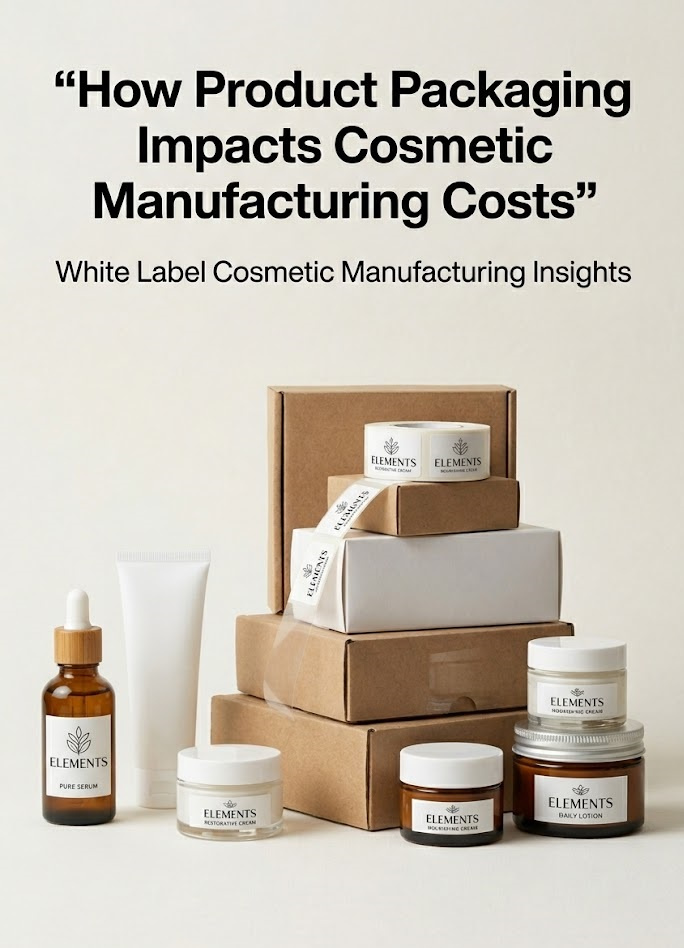
Cosmetic packaging refers to all physical materials used to store, protect, and present cosmetic products. This includes bottles, tubes, jars, caps, pumps, labeling, and secondary packaging like boxes.

But in manufacturing terms, packaging is more than appearance. It determines:

  • Unit cost of production
  • MOQ (Minimum Order Quantity)
  • Supply chain efficiency
  • Brand positioning in the market
  • Export compliance requirements

In modern OEM and private label systems, packaging is treated as a core production input, not a final branding layer.


3. Why Packaging Impacts Manufacturing Costs

Packaging affects cost in multiple hidden layers that most new brands ignore. The biggest misconception is that only material cost matters, but in reality, cost is influenced by multiple interconnected factors.

Packaging increases cost through:

  • Raw material pricing (plastic, glass, aluminium)
  • Design complexity (embossing, printing, coatings)
  • Supplier MOQ requirements
  • Transportation weight and breakage risk
  • Assembly and filling complexity
  • Compliance labeling requirements

A simple change from a plastic tube to a glass dropper bottle can increase per-unit cost by 30–80% without changing formulation at all.


4. Cost Structure Breakdown of Packaging

Below is a realistic breakdown of how packaging contributes to final cosmetic product pricing:

Cost Component Impact Level Explanation
Primary Packaging High Bottle, jar, tube, pump
Secondary Packaging Medium Box, carton, branding sleeve
Printing & Labeling Medium Branding, compliance info
MOQ Cost Factor High Bulk purchase dependency
Logistics Cost Medium Weight + fragility
Custom Mold Cost Very High One-time tooling expense

In most white-label cosmetic manufacturing setups, packaging contributes 25% to 45% of total product cost, depending on the category.


5. Types of Cosmetic Packaging and Cost Comparison

Different packaging types directly influence pricing and scalability. Choosing the wrong one can lock a brand into expensive production cycles.

Packaging Type Cost Level Branding Value Scalability Best Use Case
Plastic Bottles Low Medium High Mass skincare
Glass Bottles High High Medium Premium skincare
Airless Pumps High High Medium Serums & actives
Tubes Low–Medium Medium High Creams & gels
Jars Medium High Medium Masks & balms

Plastic remains the most scalable option, while glass and airless systems are used for premium positioning.


6. Manufacturing Process and Packaging Workflow

Packaging selection is not a single decision—it is a step-by-step manufacturing workflow.

First, brands define product positioning and target price segment. After this, manufacturers evaluate packaging compatibility with formulation type. For example, oxygen-sensitive serums require airless pumps instead of open-dropper systems.

Next comes supplier sourcing, where MOQ plays a critical role. Some packaging suppliers require 5,000 units minimum, while custom molds can go beyond 25,000 units.

Finally, branding and compliance printing are added before filling and final assembly.

In structured OEM systems like those followed by TYMK World, packaging is validated before production begins to avoid cost overruns.


7. When Brands Should Upgrade Packaging

Not every brand should start with premium packaging. Timing matters more than aesthetics.

Brands should upgrade packaging only when:

  • Product has proven demand
  • Repeat customers exist
  • Price point supports premium margins
  • Export markets are targeted

Startups often make the mistake of launching with expensive packaging before validating demand, which creates unnecessary financial pressure.


8. Who Should Focus on Packaging Strategy

Packaging importance varies depending on business model:

  • D2C skincare brands → visual appeal + branding
  • MLM companies → cost efficiency + bulk scalability
  • Export brands → compliance + durability
  • Ayurvedic brands → labeling + regulatory alignment
  • Luxury cosmetics → unboxing experience

Each category has a different packaging logic, and ignoring this leads to mismatched product-market positioning.


9. Common Mistakes Brands Make

Most cosmetic startups fail not because of formulation, but because of packaging decisions.

Common mistakes include:

  • Choosing packaging based only on looks
  • Ignoring MOQ constraints
  • Over-customizing early-stage SKUs
  • Not calculating logistics cost
  • Mixing too many packaging formats
  • Underestimating supplier lead time

These mistakes often result in a 20–50% unnecessary cost increase.


10. Real Case Study (Industry Example)

A skincare startup launched a vitamin C serum using premium glass dropper bottles. The packaging cost alone was ₹42 per unit.

After 3 months, demand increased, but profit margins remained low. The manufacturer recommended switching to airless pump packaging.

After switching:

  • Packaging cost reduced to ₹26
  • Leakage complaints dropped
  • Shelf stability improved
  • Profit margin increased by 18%

This is a typical optimization path in white-label cosmetic manufacturing systems.


11. Future Trends in Cosmetic Packaging

The packaging industry is evolving rapidly due to sustainability and D2C growth.

Key trends include:

  • Refillable packaging systems
  • Mono-material recyclable containers
  • Lightweight eco-packaging
  • Smart QR-based packaging
  • Minimalist design trends
  • Hybrid material innovations

Future packaging will focus more on cost efficiency + sustainability balance rather than visual luxury alone.


12. Brand Insight: TYMK World

TYMK World focuses on integrated cosmetic manufacturing, where packaging is treated as a core cost and scalability factor.

Their approach includes:

  • Packaging-first feasibility planning
  • MOQ optimization before production
  • Export-compliant packaging selection
  • Cost breakdown modeling for startups
  • OEM + private label integration

This reduces the risk of brands entering production with unrealistic packaging expectations.


13. Featured Snippet Answer

Cosmetic packaging directly affects manufacturing cost by influencing material selection, MOQ requirements, printing complexity, logistics weight, and branding design. It can contribute up to 40% of total product cost, making it one of the most important factors in cosmetic pricing and scalability.


14. FAQs

What is cosmetic packaging in manufacturing?

It refers to bottles, tubes, jars, labeling, and secondary packaging used to store and present cosmetic products during production.

How does packaging affect cost?

It affects raw material pricing, MOQ, transportation cost, branding complexity, and compliance requirements.

Which packaging is most cost-effective?

Plastic bottles and tubes are the most cost-effective and scalable options for mass production.

Is glass packaging expensive?

Yes, glass packaging increases both material and logistics costs, but improves premium branding perception.

Can packaging reduce profit margins?

Yes, over-designed or low-MOQ packaging can significantly reduce profitability.


15. Conclusion

Packaging is not a visual decision—it is a financial and strategic manufacturing decision. It directly influences cost structure, scalability, and brand positioning in cosmetic production.

Brands that understand packaging economics early avoid unnecessary cost escalation and build stronger long-term margins in white-label cosmetic manufacturing.


Recent Posts

call to +918128153295
sent message to whatsapp
contact now