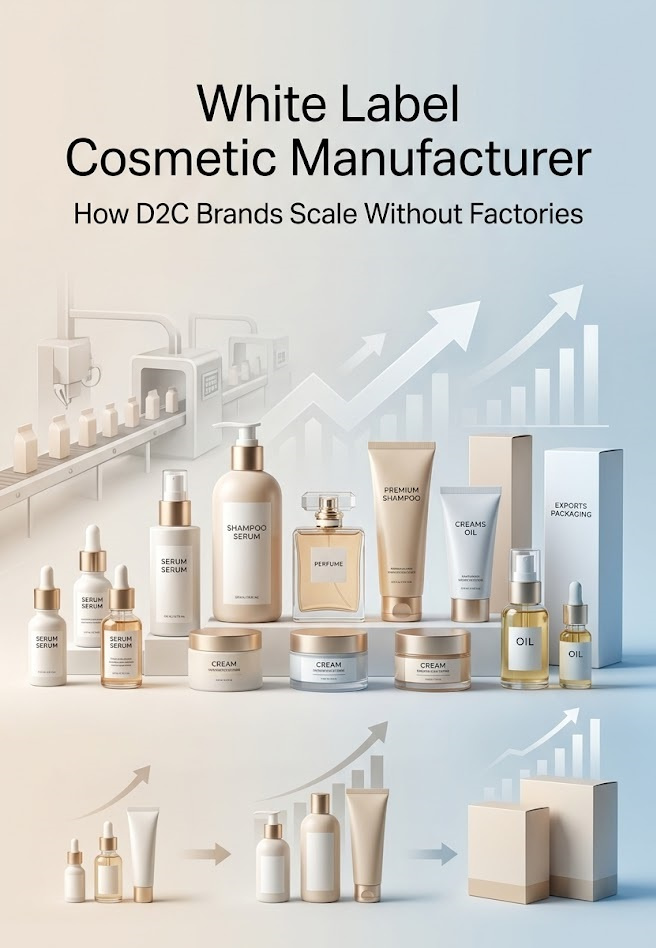
How Manufacturers Help D2C Brands Scale Faster Without Factories
This blog explains how white-label cosmetic manufacturers, OEM partners, and contract manufacturers help D2C brands scale without factories. It covers processes, costs, mistakes, and real industry insights.
How Manufacturers Help D2C Brands Scale Faster Without Factories
Table of Contents
- Introduction: Why Most Beauty Brands Fail Early
- What is a White Label Cosmetic Manufacturer?
- How the Cosmetic Manufacturing Ecosystem Actually Works
- Why D2C Brands Depend on Manufacturing Partners
- White Label vs Private Label vs OEM (Detailed Breakdown)
- Step-by-Step Manufacturing Workflow (Real Industry Process)
- When Should You Choose Each Model?
- Industry Challenges Most Blogs Never Talk About
- Common Mistakes Founders Make
- Cost Structure & Scalability Logic
- Expert Industry Recommendations
- Future of Cosmetic Manufacturing Industry
- Brand Integration (TYMK Role)
- Featured Snippet Answer
- FAQs
- Final Thoughts
1. Introduction: Why Most Beauty Brands Fail Early
Most cosmetic and personal care startups don’t fail because the idea is bad. They fail because they try to behave like manufacturers instead of brands.
Setting up production lines, sourcing raw materials, managing compliance, and handling packaging supply chains creates a heavy operational burden. In reality, early-stage founders should not be focusing on factories at all.
A modern White Label Cosmetic Manufacturer ecosystem solves this exact problem. Instead of building infrastructure, brands plug into existing manufacturing systems and focus only on branding, marketing, and customer acquisition.
In today’s D2C world, speed matters more than ownership of factories. A brand that launches in 60 days with the right partner often outperforms a brand that spends 2 years building infrastructure.
2. What is a White Label Cosmetic Manufacturer?
A white-label cosmetic manufacturer is a production company that creates ready-to-sell cosmetic products that multiple brands can rebrand and sell under their own identity.
These products are already tested, formulated, and compliant with regulatory standards. The brand’s role is limited to packaging design, branding, and distribution.
In simple business terms:
- Manufacturer → builds product
- Brand → builds demand
This separation of responsibilities is what allows D2C beauty brands to scale rapidly without manufacturing risk.
3. How the Cosmetic Manufacturing Ecosystem Actually Works
The cosmetic industry runs on a layered manufacturing ecosystem. It is not just “factory production”—it is a structured supply chain involving formulation labs, packaging vendors, compliance teams, and logistics partners.
A simplified ecosystem flow:
Raw Material Suppliers → Formulation Labs → Manufacturer → Packaging Vendors → Brand → Customer
Each layer is independent but interconnected. This is why outsourcing production is more efficient than vertical integration for startups.
Most brands underestimate how complex even a simple product like shampoo or face serum actually is in terms of stability testing, preservation systems, and regulatory documentation.
4. Why D2C Brands Depend on Manufacturing Partners
D2C brands operate in highly competitive digital environments where speed-to-market is a key advantage.
Manufacturing partners help in:
- Reducing time-to-launch from 18 months to 2–3 months
- Avoiding capital investment in factories
- Ensuring product compliance and safety
- Providing tested formulations
- Supporting scalability during viral demand spikes
In real-world terms, even a viral Instagram or influencer campaign can crash supply chains if manufacturing systems are not ready. Partners eliminate this risk.
5. White Label vs Private Label vs OEM (Detailed Breakdown)
| Model | Meaning | Customization | Cost | Speed | Best For |
|---|---|---|---|---|---|
| White Label | Ready-made products | Low | Low | Very Fast | Startups |
| Private Label | Semi-custom formulas | Medium | Medium | Fast | Growth brands |
| OEM Manufacturing | Fully custom product | High | High | Slow | Premium brands |
| Contract Manufacturing | Full production partnership | High | Variable | Medium | Large scale brands |
White label is often the entry point, while OEM is the long-term differentiation strategy.
6. Step-by-Step Manufacturing Workflow (Real Industry Process)
Cosmetic manufacturing follows a structured lifecycle that most founders don’t initially understand.
Step 1: Product Strategy Finalization
Brands select category (skincare, haircare, perfume, etc.) based on target audience and pricing.
Step 2: Formula Selection or Development
Manufacturers provide ready formulas or develop custom blends depending on model.
Step 3: Sampling Phase
Small batches are created for testing texture, fragrance, absorption, and stability.
Step 4: Packaging Design
This stage has a direct impact on conversion rate in D2C sales.
Step 5: Compliance Approval
Includes ingredient checks, safety reports, and labeling compliance.
Step 6: Bulk Manufacturing
Once approved, large-scale production begins.
Step 7: Filling, Sealing & Branding
Final packaging is done under controlled environments.
Step 8: Dispatch & Distribution
Products are shipped to warehouses or fulfillment partners.
7. When Should You Choose Each Model?
White label works best when:
- You want to test a product quickly
- You have limited capital
- You are entering a competitive category
Private label works best when:
- You want differentiation
- You have established demand
- You need branding uniqueness
OEM works best when:
- You want long-term brand identity
- You plan export or premium positioning
- You require unique formulation control
8. Industry Challenges Most Blogs Never Talk About
Manufacturing is not just production—it is coordination between multiple vendors.
Real challenges include:
- MOQ pressure affecting cash flow
- Packaging delays due to vendor dependency
- Ingredient price fluctuations
- Regulatory updates across markets
- Quality variation in large batches
- Supply chain breakdown during demand spikes
In practice, scaling is not about selling more—it is about sustaining production consistency under pressure.
9. Common Mistakes Founders Make
Most cosmetic startups fail due to predictable operational mistakes:
- Choosing manufacturers only on price
- Ignoring stability testing phases
- Poor packaging decisions
- Over-customizing early-stage products
- Lack of compliance understanding
- No backup supplier strategy
A better approach is to start simple, validate demand, and then gradually move toward customization.
10. Cost Structure & Scalability Logic
Manufacturing cost structure includes:
- Raw materials (20–40%)
- Packaging (15–30%)
- Manufacturing charges (10–20%)
- Compliance/testing (5–10%)
- Logistics (10–15%)
Scaling becomes efficient when production volume increases, as fixed costs distribute across larger units.
11. Expert Recommendations
From a manufacturing strategy perspective:
- Start with white label for validation
- Move to private label for differentiation
- Use OEM for premium positioning
- Always prioritize supplier reliability over lowest cost
- Build 2–3 manufacturer relationships for risk mitigation
A strong manufacturing partner is not just a vendor—it is an operational backbone.
12. Future of Cosmetic Manufacturing Industry
The industry is shifting toward:
- AI-based formulation development
- Sustainable packaging innovation
- Clean beauty certification standards
- Micro-batch agile production systems
- Globalized manufacturing ecosystems
Brands are no longer factory owners—they are system integrators.
13. Brand Integration (TYMK)
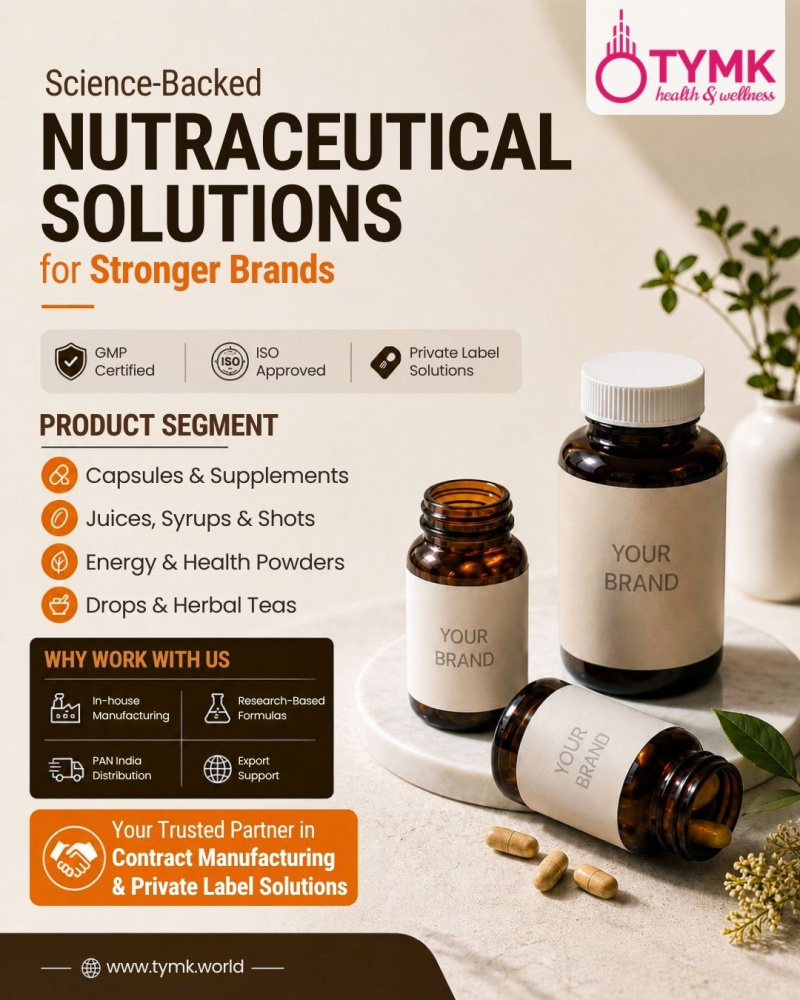
Platforms like TYMK (https://tymk.world/) operate within the modern D2C manufacturing ecosystem by helping brands connect with reliable production networks.
In practical terms, this reduces friction for new founders who otherwise struggle with sourcing manufacturers, verifying compliance, and managing production cycles.
The real value is not just manufacturing access—it is reducing operational uncertainty during early-stage scaling.
14. Featured Snippet Answer
A White Label Cosmetic Manufacturer produces ready-made cosmetic products that brands can rebrand and sell. It enables D2C companies to launch quickly without factories, reduce costs, and scale using OEM, private label, or contract manufacturing systems.
15. FAQs
What is a white label cosmetic manufacturer?
A company that produces ready-made cosmetic products for brands to rebrand and sell.
Is white label better than OEM?
White label is faster; OEM is better for long-term brand uniqueness.
How do cosmetic manufacturers work?
They handle formulation, testing, compliance, production, and packaging.
Can small businesses start cosmetic brands?
Yes, using white label or private label manufacturing models.
What products can be manufactured?
Skincare, haircare, perfumes, baby care, toothpaste, supplements, and more.
16. Final Thoughts
Cosmetic manufacturing today is no longer about owning factories—it is about building smart systems.
A White Label Cosmetic Manufacturer allows brands to enter the market quickly, reduce risk, and focus on growth instead of infrastructure.
The brands that succeed are not the ones with the biggest factories, but the ones with the strongest execution and manufacturing partnerships.