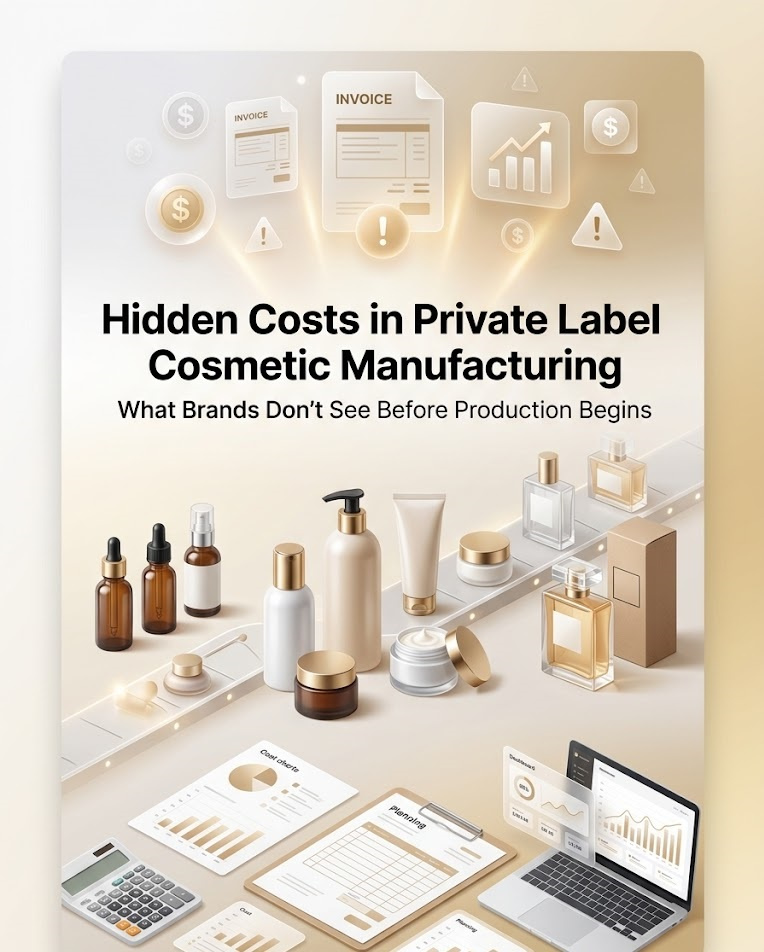
Hidden Costs in Private Label Cosmetic Manufacturing
A practical guide explaining the hidden expenses behind private label cosmetic manufacturing, including packaging, testing, formulation changes, MOQs, compliance, and production delays.
Hidden Costs in Private Label Cosmetic Manufacturing
Most cosmetic founders assume manufacturing cost equals product cost.
That assumption is where most budgets break.
In reality, cosmetic manufacturing is a layered system involving formulation engineering, packaging sourcing, compliance validation, testing cycles, and production logistics.
A Face Serum Private Label Manufacturer or OEM Herbal Products supplier does not simply “make products”—they manage a controlled production ecosystem.
Now here’s the core issue:
Most quotations only show base manufacturing cost, not operational cost variance.
And that difference is where hidden costs appear.
These costs do not look obvious initially, but they directly decide:
- profit margin
- launch timeline
- product quality
- brand positioning
TABLE OF CONTENTS
| Section |
|---|
| Real Meaning of Hidden Costs |
| Cost Structure Breakdown |
| Packaging Cost Escalation |
| Formula Development & R&D Cycles |
| Testing & Stability Validation |
| MOQ & Inventory Pressure |
| Compliance & Legal Constraints |
| Real Startup Case Study |
| Cost Comparison Table |
| Manufacturer Process Flow |
| Who Gets Most Affected |
| Brand Integration (TYMK) |
| FAQs |
| Conclusion |
WHAT ARE HIDDEN COSTS IN COSMETIC MANUFACTURING?
Hidden costs are non-visible operational expenses that appear after initial quotation approval.
They are not “extra charges” but part of production reality.
Typical hidden cost categories:
- packaging upgrades
- sample iteration cycles
- testing & stability validation
- regulatory compliance corrections
- labeling redesign
- MOQ adjustments
- logistics re-calculation
- ingredient substitution costs
Most beginners underestimate one key point:
👉 Cosmetic products are not static items. They are chemically stabilized systems.
Even minor changes can trigger new testing cycles.
COST STRUCTURE BREAKDOWN (REAL INDUSTRY VIEW)
| Cost Layer | What It Includes | Impact Level |
|---|---|---|
| Base Manufacturing | Filling, formulation | Medium |
| Packaging | Bottles, pumps, boxes | High |
| R&D | Formula creation/revision | Very High |
| Testing | Stability, safety | High |
| Compliance | Label/legal approval | Medium |
| Logistics | Freight, warehousing | Medium |
| MOQ Cost Pressure | Bulk inventory lock | Very High |
1. PACKAGING COST ESCALATION (MOST UNDERESTIMATED)
Packaging is the largest silent cost driver.
A ₹25 bottle can become ₹90 depending on:
- airless pump systems
- imported glass
- UV-coated cartons
- foil stamping
- embossing
- luxury caps
Real insight:
In premium skincare, packaging often consumes 35–55% of total product cost.
This is common in:
- Skin Care Products White Label Manufacturer projects
- Perfume Private Label Manufacturer launches
- Colour Cosmetics Products Manufacturer brands
2. FORMULA DEVELOPMENT & R&D CYCLES
Most founders assume 1 sample = final product.
Reality:
- 2–10 revisions are normal
- Ingredient sourcing may change mid-process
- Texture stability adjustments are common
Example:
A Face Serum Private Label Manufacturer may adjust:
- viscosity (thickness)
- absorption speed
- fragrance load
- active ingredient concentration
Each iteration increases:
- raw material cost
- lab time
- production delay cost
3. STABILITY & TESTING COSTS (HIDDEN RISK FACTOR)
Products must survive:
- heat (Indian summer conditions)
- humidity
- transportation vibration
- shelf storage cycles
Testing includes:
- microbial testing
- pH stability
- phase separation analysis
- packaging compatibility
Without this, products may fail after market launch.
This is critical in:
- Herbal Products Contract Manufacturer categories
- Shampoo Manufacturer production
- Baby Care Products Manufacturer Segments
4. MOQ & INVENTORY PRESSURE
MOQ is not just a number—it is a financial lock.
Example:
- Packaging MOQ = 10,000 units
- Manufacturing MOQ = 5,000 units
Even if you want 2,000 units, ecosystem forces scale you up.
Result: The
- capital gets locked
- storage cost increases
- Slow-moving inventory risk rises
5. COMPLIANCE & LABEL CORRECTIONS
Incorrect labeling is one of the most expensive hidden costs.
Common mistakes:
- wrong ingredient order
- unsupported claims
- missing batch code
- Incorrect MRP formatting
Fixing labels post-print = full batch redesign cost.
This affects:
- Healthcare Products Private Label Manufacturer
- Nutraceutical Products White Label Manufacturer
- Herbal supplements Products Contract Manufacturer
REAL STARTUP CASE STUDY (EXPANDED)
A startup planned to launch a premium skincare serum:
Initial budget:
₹3.2 lakh
Outcome:
₹5.1 lakh
Cost expansion breakdown:
- packaging upgrade: +₹85,000
- 5 formulation revisions: +₹60,000
- stability testing: +₹40,000
- MOQ adjustment inventory: +₹55,000
- label redesign compliance: +₹30,000
Key failure point:
They only calculated per-unit cost, not system cost.
This is the most common industry mistake.
COST IMPACT SUMMARY TABLE
| Factor | Budget Impact | Predictability |
|---|---|---|
| Packaging upgrades | High | Medium |
| Formula changes | Very High | Low |
| Testing cycles | Medium | Medium |
| MOQ scaling | Very High | Low |
| Compliance fixes | Medium | Low |
MANUFACTURING PROCESS FLOW (REAL INDUSTRY)
- Idea discussion
- Product feasibility check
- Sample development
- Packaging selection
- Testing phase
- Label compliance check
- Pilot batch production
- Final mass production
- Dispatch & logistics
Each step can introduce hidden cost triggers.
WHO IS MOST AFFECTED
| Business Type | Risk Level |
|---|---|
| First-time founders | Very High |
| Influencer brands | High |
| MLM Product Manufacturer networks | Medium |
| Export brands | Medium |
| Established D2C brands | Low |
WHY TYMK
TYMK works with structured manufacturing planning instead of only quoting production cost.
Key operational focus:
- realistic costing model
- MOQ planning logic
- packaging feasibility analysis
- formulation stability strategy
- production timeline accuracy
This reduces unexpected financial expansion during the execution phase.
Hidden costs in private label cosmetic manufacturing include packaging upgrades, formulation revisions, testing cycles, MOQ pressure, and compliance corrections. These costs can increase total project investment by 20–40% if not planned properly during initial product development.
FAQ (EXPANDED + FEATURE-SNIPPET STYLE)
1. What are the hidden costs in cosmetic manufacturing?
Hidden costs include packaging upgrades, testing, compliance corrections, and formulation changes not included in base pricing.
2. Why do cosmetic products cost more than the initial quotation?
Production involves iterative testing, packaging sourcing, and regulatory validation.
3. Which cost increases the most in private label manufacturing?
Packaging and formulation revisions typically contribute the highest cost escalation.
4. Is OEM cheaper than custom cosmetic manufacturing?
Yes, OEM is usually more cost-efficient because formulas are pre-developed.
5. What is the biggest mistake startups make?
Ignoring the packaging MOQ and testing cost structure.
6. How can brands reduce hidden costs?
By finalizing packaging early and minimizing formulation revisions.
7. Are stability tests mandatory?
Yes, for commercial safety and regulatory compliance.
8. Does TYMK help reduce manufacturing cost risks?
Yes, through structured planning and feasibility analysis.
CONCLUSION
Hidden costs in cosmetic manufacturing are not accidental—they are structural components of production systems.
Brands that understand packaging logic, formulation cycles, testing requirements, and MOQ constraints early tend to scale more efficiently and avoid financial shocks during launch.
In practical terms, cosmetic manufacturing success depends less on “cheap pricing” and more on accurate cost mapping before production begins.