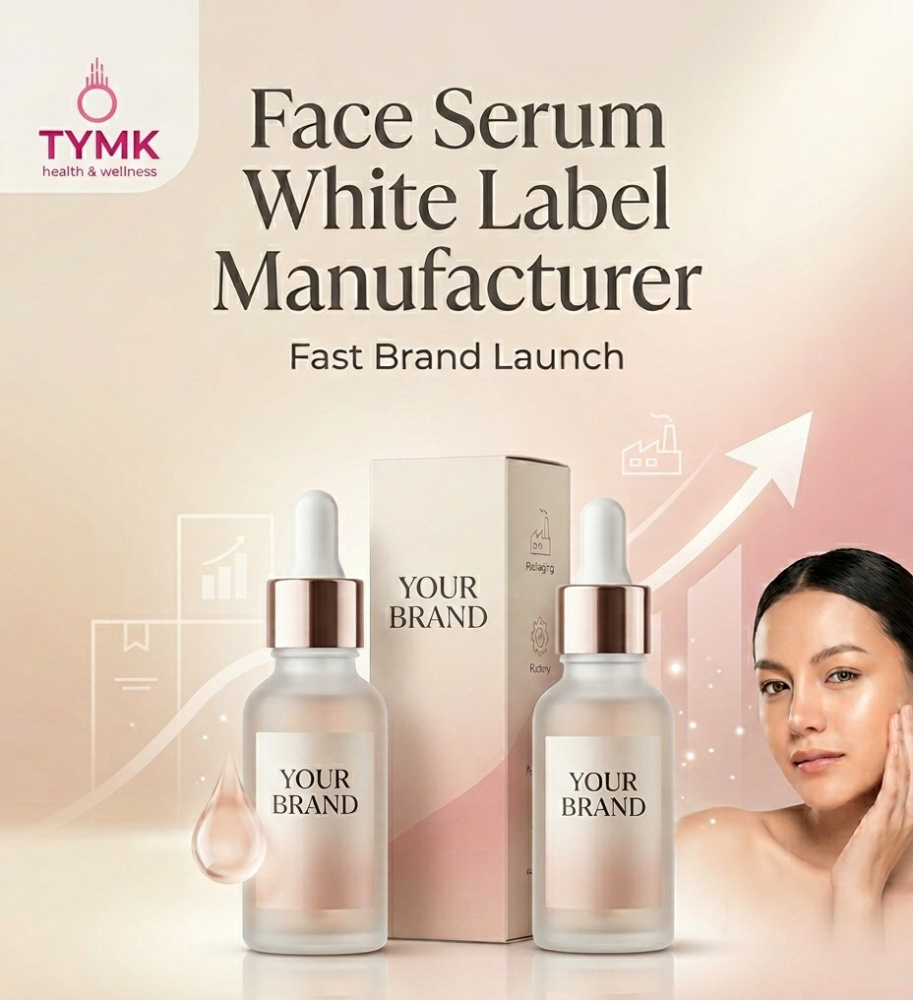
Face Serum White Label Manufacturer for Fast Brand Launch
Face Serum White Label Manufacturer helping skincare brands launch custom and ready-to-market serum products with OEM, private label, and contract manufacturing support for scalable business growth.
Face Serum White Label Manufacturer for Fast Brand Launch
Face Serum White Label Manufacturer offering private label skincare production, OEM solutions, and scalable serum development for beauty brands.
Most people entering skincare assume the hard part is branding or marketing.
It is not.
The real bottleneck usually appears much earlier — formulation, compliance, and production stability. This is exactly where a Face Serum White Label Manufacturer becomes relevant.
Instead of building labs or hiring chemists, brands directly work with existing production systems and adapt ready formulations. In practice, this reduces launch time from months (sometimes years) to a few weeks.
TYMK World operates in this space by supporting cosmetic brands that want to move quickly without compromising formulation control.
What is Face Serum White Label Manufacturing?
A white-label serum is basically a pre-developed formulation that can be rebranded.
But in real manufacturing environments, it’s not always “fully ready products on a shelf” as many assume.
There are usually 3 layers:
- Base formulation (standard serum)
- Modified actives (brand-specific adjustment)
- Packaging + compliance finalization
So the manufacturer is not just producing — they are stabilizing a product for market use.
Why is this model used so widely now?
Skincare demand has increased sharply, especially for serums like Vitamin C and Niacinamide.
But here’s the practical issue most new brands face:
They don’t fail at selling — they fail at production consistency.
White label manufacturing solves this by:
- Removing R&D dependency
- Avoiding lab setup costs
- Ensuring batch consistency
- Speeding up product launch cycles
In simple terms, it removes technical delay from business execution.
How the process usually works (real flow)
It looks structured on paper, but in real production, it is iterative.
- Formula selection (often 2–3 options are tested)
- Stability check (this step takes longer than expected)
- Sample corrections (usually 1–2 revisions minimum)
- Bulk production approval
- Packaging alignment (this is where most delays happen)
Packaging is often underestimated. A minor label or bottle issue can delay a full batch.
When should a brand use white-label serum manufacturing?
Not every brand needs this model.
It works best when:
- You want fast entry into skincare
- You are testing market demand
- You don’t have internal chemists or labs
- You want a controlled cost structure in the early stage
If the goal is deep formulation innovation, OEM is usually better.
Who actually uses this model?
In practice, most users fall into predictable categories:
- Startup skincare brands
- MLM / direct selling networks
- Dermatology-led product lines
- Influencer-led cosmetic brands
- Export-focused cosmetic traders
Each of these has one common requirement: speed over experimentation.
Simple comparison table
| Model | Reality | Speed | Control |
|---|---|---|---|
| White Label | Pre-developed base | Fast | Medium |
| OEM | Semi-custom formulation | Medium | High |
| Contract Manufacturing | Full development cycle | Slow | Very High |
Brand context: TYMK World
TYMK World works as a manufacturing support system for cosmetic and personal care brands.
What it typically handles:
- Skincare and serum manufacturing coordination
- White label product structuring
- OEM and private label support
- Scaling production for growing brands
Official reference: TYMK World
A Face Serum White Label Manufacturer TYMK World produces ready-formulated skincare serums that brands can rebrand and sell. It reduces development time, lowers production cost, and allows faster entry into the skincare market without requiring in-house formulation or laboratory setup.
Real case scenario
A small beauty brand initially planned full in-house serum development. After 3 months, they still had no stable formulation due to ingredient incompatibility issues.
They switched to a white-label manufacturer instead.
Within ~6 weeks:
- The formula was finalized
- Packaging was approved
- The first production batch was completed
The key difference was not quality — it was time lost earlier in experimentation.
FAQs
What is a white-label face serum manufacturer?
A manufacturer that produces pre-formulated serums that brands can sell under their own name.
Is white label better than OEM?
Depends on the control level. White label is faster; OEM is more customizable.
How long does production take?
Typically, 30–60 days depending on packaging and formulation changes.
Is it suitable for new brands?
Yes, especially for brands testing market demand.
What does TYMK World do in this space?
It supports cosmetic brands with manufacturing coordination and product development systems.
Indian cosmetic compliance framework:
CDSCO Cosmetics Regulation