EU Fragrance Allergen Labelling 2026: 82-Allergen Expansion & Compliance Guide for Cosmetic Brands
EU Regulation 2023/1545 expands fragrance allergen disclosure requirements for cosmetics, with 31 July 2026 becoming a key compliance date for newly placed products. Explore the updated allergen framework, thresholds, affected cosmetic categories, supplier documentation, CPSR, PIF, artwork and regulatory steps brands should review before entering the EU market.
EU Fragrance Allergen Labelling 2026: What Cosmetic Brands Need to Know Before 31 July
The European cosmetics industry is approaching an important regulatory deadline.
From 31 July 2026, cosmetic products newly placed on the European Union market must comply with the expanded fragrance allergen labelling requirements introduced under Commission Regulation (EU) 2023/1545, which amended Annex III of Regulation (EC) No 1223/2009.
The update significantly expands the number of fragrance allergens that may need to be individually declared on cosmetic labels and has major implications for cosmetic brands, exporters, private label manufacturers, fragrance suppliers and regulatory teams.
For businesses planning to manufacture or export cosmetics to Europe, this is the right time to review formulations, fragrance documentation, product labels and regulatory dossiers.
What Is the EU Fragrance Allergen Expansion?
The European Union has required certain fragrance allergens to be individually declared on cosmetic ingredient lists for many years.
Following an assessment by the Scientific Committee on Consumer Safety, the European Commission introduced Regulation (EU) 2023/1545. The amendment added 56 additional fragrance allergens to the existing framework for individual allergen declaration.
These substances may be present not only in added perfume compositions but also in essential oils, botanical materials and other aromatic raw materials.
The objective of the expanded disclosure requirement is to provide consumers, particularly fragrance-sensitive individuals, with clearer information about potential fragrance allergens present in cosmetic products.
Why Is 31 July 2026 Important?
The regulation provides two important transition dates.
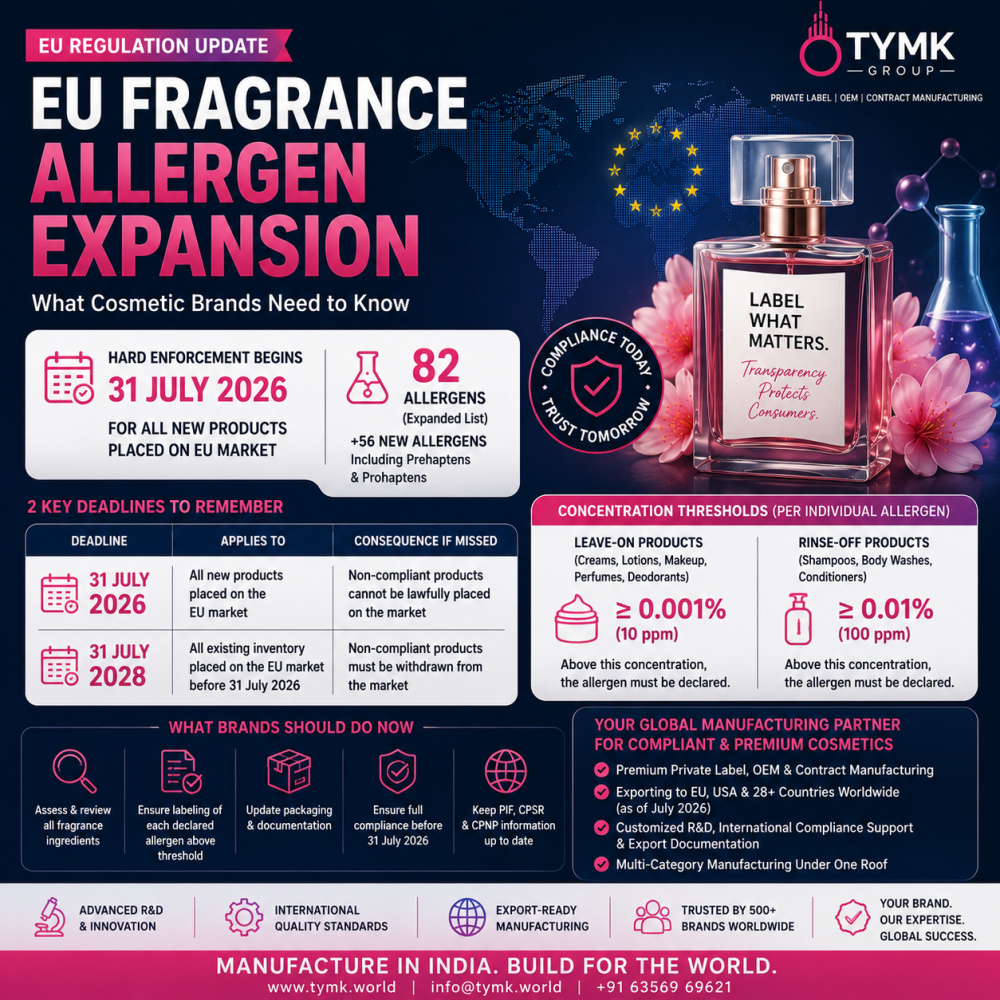
31 July 2026
New cosmetic products placed on the EU market after this date must comply with the updated fragrance allergen labelling requirements.
Brands developing new products for Europe should therefore ensure that their formulation assessment, ingredient list and artwork are compliant before placing the products on the market.
31 July 2028
Products that were already placed on the EU market under the previous labelling regime benefit from a longer transition period.
Non-compliant legacy products must no longer remain available on the EU market after the applicable transition period ends.
For brands operating internationally, the practical message is simple:
Do not wait until artwork printing or shipment preparation to review allergen compliance.
What Changed in the Fragrance Allergen Rules?
The amendment substantially expands the number of fragrance allergens subject to individual labelling requirements.
The update includes additional fragrance molecules, natural aromatic substances and related compounds identified as potential contact allergens.
Examples include substances associated with:
-
Essential oils
-
Botanical extracts
-
Perfume compositions
-
Aroma ingredients
-
Naturally occurring fragrance components
-
Oxidation-related fragrance allergens
This means even products positioned as botanical, herbal or naturally fragranced may require detailed allergen assessment.
What Are the Labelling Thresholds?
The concentration thresholds for individual allergen declaration remain:
Leave-On Cosmetic Products
Above 0.001%
This category can include:
-
Face Creams
-
Body Lotions
-
Serums
-
Perfumes
-
Deodorants
-
Makeup
-
Leave-On Hair Products
Rinse-Off Cosmetic Products
Above 0.01%
This category can include:
-
Shampoos
-
Body Washes
-
Shower Gels
-
Face Washes
-
Conditioners
-
Cleansing Products
The threshold applies to the concentration of the individual allergen in the finished cosmetic product.
Natural Ingredients Are Not Automatically Exempt
One of the most important compliance points for cosmetic brands is that fragrance allergens can originate from ingredients other than the declared perfume.
Essential oils and natural aromatic ingredients may naturally contain substances that become declarable when their concentration in the finished product exceeds the applicable threshold.
Therefore, a product cannot automatically be considered exempt simply because the formulation does not contain a conventional perfume compound.
Brands should obtain suitable allergen information from suppliers of fragrances, essential oils and relevant botanical materials.
Which Cosmetic Products May Be Affected?
The regulation can affect a wide range of cosmetic categories, including:
-
Skin Care Products
-
Face Creams & Serums
-
Body Lotions
-
Shampoos & Conditioners
-
Hair Styling Products
-
Shower Gels & Body Washes
-
Soaps
-
Perfumes & Eau de Parfum
-
Body Sprays
-
Deodorants
-
Color Cosmetics
-
Lip Products
-
Sunscreen Cosmetics
-
Baby & Children’s Cosmetics
-
Professional Salon Products
Any formulation containing fragrance allergens above the applicable threshold must be assessed for individual declaration.
Documents Brands Should Review
EU cosmetic compliance goes beyond changing the printed ingredient list.
Brands should review the complete regulatory documentation associated with the product.
1. Fragrance Allergen Declaration
Obtain an updated allergen breakdown from the fragrance supplier covering the expanded EU requirements.
An IFRA certificate alone may not provide all information required for finished-product allergen declaration.
2. Cosmetic Product Safety Report – CPSR
Where the composition or allergen information changes, the product safety documentation should be reviewed by the appropriate qualified safety assessor.
3. Product Information File – PIF
The PIF should remain consistent with the current formulation, supplier documentation, safety assessment and product artwork.
4. Ingredient List & Artwork
The product label must use the appropriate ingredient terminology required by the applicable EU cosmetic framework.
Artwork should be reviewed before mass printing.
5. CPNP Information
Where relevant information regarding the cosmetic product changes, brands and their EU Responsible Person should ensure that the Cosmetic Products Notification Portal record remains current.
Why Fragrance Supplier Documentation Matters
For manufacturers, one of the biggest operational challenges may be obtaining complete allergen information from fragrance suppliers.
Before finalising EU artwork, brands should request current documentation identifying the allergens present in the fragrance and their concentration or relevant disclosure data.
For formulations containing essential oils or natural fragrance materials, additional raw material documentation may also be required.
This information allows the finished-product concentration of each relevant allergen to be evaluated against the applicable EU threshold.
What Happens If a Cosmetic Product Is Non-Compliant?
Cosmetic products placed on the European market must comply with applicable EU cosmetic legislation.
Depending on the circumstances and action taken by national authorities, non-compliance can result in measures such as:
-
Product Withdrawal
-
Product Recall
-
Sales Restrictions
-
Customs or Market Surveillance Intervention
-
Corrective Labelling Requirements
-
Regulatory Investigation
For exporters, late identification of an artwork or ingredient-list problem can also lead to additional costs associated with reprinting, relabelling, shipment delays and inventory management.
What Should Cosmetic Brands Do Now?
Brands preparing products for the European market should begin with a structured review.
Step 1 — Identify EU-Bound Products
Prepare a list of cosmetic SKUs intended for EU distribution.
Step 2 — Review Fragrances & Aromatic Raw Materials
Identify products containing:
-
Parfum
-
Aroma
-
Essential Oils
-
Botanical Aromatic Extracts
-
Natural Fragrance Ingredients
Step 3 — Obtain Updated Supplier Allergen Information
Request documentation suitable for assessment against Regulation (EU) 2023/1545.
Step 4 — Calculate Finished-Product Allergen Levels
Determine whether each relevant allergen exceeds:
0.001% for leave-on products
or
0.01% for rinse-off products
Step 5 — Update Regulatory Documentation & Artwork
Coordinate the formulation documentation, CPSR, PIF, product artwork and regulatory notification information before commercial placement.
What This Means for Private Label Cosmetic Brands
For private label, white label and OEM cosmetic businesses, regulatory planning must begin during formulation and packaging development—not after production.
International brands increasingly expect their manufacturing partners to understand:
-
EU Cosmetic Regulations
-
Fragrance Allergen Compliance
-
INCI Labelling
-
Product Documentation
-
Export Requirements
-
Cosmetic Safety Documentation
At TYMK Group, regulatory requirements are considered alongside product development and manufacturing when working on cosmetic projects intended for international markets.
Early review can help brands avoid formulation changes, artwork revisions and unnecessary delays close to dispatch.
Frequently Asked Questions
What is the EU fragrance allergen deadline in 2026?
For products covered by the transition, 31 July 2026 is the key date after which newly placed cosmetic products must meet the updated requirements of Regulation (EU) 2023/1545.
How many new fragrance allergens were added?
The European Commission amendment followed the SCCS identification of 56 additional fragrance allergens requiring expanded individual labelling provisions.
Are the thresholds changing?
The established individual declaration thresholds remain 0.001% for leave-on products and 0.01% for rinse-off products.
Do essential oils need allergen assessment?
Yes. Naturally occurring fragrance allergens in essential oils and other natural aromatic materials may require declaration when present above the applicable threshold in the finished cosmetic product.
Is an IFRA Certificate Enough?
Not necessarily.
An IFRA certificate primarily addresses fragrance use according to applicable IFRA standards. Brands may require a detailed allergen declaration or compositional information to determine finished-product EU labelling requirements.
Final Takeaway
The expanded EU fragrance allergen requirements represent a major labelling change for cosmetic brands selling into Europe.
Manufacturers, exporters and brand owners should use the remaining transition period to review:
Formulations → Fragrance Data → Allergen Calculations → CPSR → PIF → Artwork → Regulatory Notifications
Brands that integrate regulatory assessment early into product development will be better positioned to launch smoothly in the European market.
TYMK Group | Private Label • White Label • OEM • Third-Party & Contract Manufacturing
How TYMK Group Can Help Brands Prepare for EU Cosmetic Compliance
For cosmetic brands, compliance with evolving international regulations is not simply a documentation exercise. Regulatory requirements can influence formulation development, fragrance selection, raw material sourcing, ingredient declarations, packaging artwork, testing, manufacturing and export planning.
This is where working with an experienced international manufacturing partner becomes especially important.
TYMK Group is a premium private label, OEM, third-party and contract manufacturing group from India, serving brands across international markets including the European Union, the United States and 28+ countries worldwide as of July 2026.
Our international manufacturing and export experience enables us to understand that a product intended for Europe or America cannot always be developed in exactly the same way as a product intended only for the Indian domestic market.
For export-oriented cosmetic projects, TYMK Group can work with brands on areas such as:
✔️ Customized Product Formulation
Development of cosmetic and personal care formulations according to the brand's positioning, target consumer, product category and destination market requirements.
✔️ Fragrance & Allergen Documentation Coordination
Reviewing fragrance documentation and coordinating updated allergen information from fragrance suppliers so that relevant declarations can be assessed before artwork finalization.
✔️ Ingredient & INCI Review
Supporting brands in preparing accurate ingredient information and internationally recognized INCI terminology appropriate for cosmetic labels.
✔️ Export-Oriented Product Development
Considering the destination market at the development stage so that formulation, packaging and documentation decisions are taken with international commercialization in mind.
✔️ Label & Artwork Review Support
Helping identify formulation-related information required for ingredient declarations and coordinating documentation before bulk printing of packaging materials.
✔️ Manufacturing & Quality Systems
Providing professional manufacturing infrastructure for private label, white label, OEM and contract manufacturing projects intended for domestic and international markets.
✔️ Regulatory Documentation Support
Supporting brands with manufacturer-side technical documents required for regulatory dossiers, product registration and international export processes, subject to the requirements of the destination country.
✔️ International Export Experience
With products supplied to the EU, USA and 28+ countries worldwide, TYMK Group understands the additional planning required when developing products for international brands and regulated markets.
Why International Brands Choose TYMK Group
Launching a premium cosmetic brand requires much more than finding a factory that can manufacture a formula.
International brands increasingly need a manufacturing partner capable of understanding the complete journey:
Concept → R&D → Formulation → Raw Materials → Testing → Manufacturing → Packaging → Documentation → Compliance Coordination → Export
TYMK Group combines product development, multi-category manufacturing capability, customization and international export experience to help brands develop products designed for today's competitive global beauty and personal care market.
Whether the requirement is for:
-
Premium Skin Care
-
Hair Care
-
Baby Personal Care
-
Perfumes & Fragrances
-
Bath & Body Products
-
Colour Cosmetics
-
Herbal & Natural Cosmetics
-
Customized Personal Care Products
TYMK Group works with startups, established brands, importers, distributors and international businesses looking for an experienced manufacturing partner in India.
Built for Premium & Global Brands
For brands planning European expansion, the 2026 fragrance allergen requirements demonstrate why regulatory planning should start before production—not after the products are manufactured.
Selecting fragrance, finalizing formulation percentages and printing thousands of labels before completing the required regulatory review can lead to expensive artwork changes, shipment delays and product rework.
At TYMK Group, export-market requirements can be considered from the product-development stage itself, helping brands build a stronger foundation for international commercialization.
Manufacture in India. Build for the World.
TYMK Group — Premium Private Label | White Label | OEM | Third-Party | Contract Manufacturing
Serving brands across the European Union, United States and 28+ countries worldwide.
Planning to Launch or Export Cosmetics to Europe?
The EU fragrance allergen expansion is another reminder that international cosmetic manufacturing requires the right combination of formulation expertise, manufacturing capability, documentation and regulatory awareness.
For brands developing cosmetics for the European Union, USA or other international markets, working with an export-experienced manufacturer can help identify compliance considerations much earlier in the development process.
TYMK Group offers premium Private Label, White Label, OEM, Third-Party and Contract Manufacturing solutions for brands seeking customized cosmetic and personal care products from India.
🌍 Export Experience: EU | USA | 28+ Countries Worldwide
🏭 Multi-Category Manufacturing
🧪 Customized R&D & Product Development
📋 Export Documentation & Regulatory Coordination Support
🎨 Customized Packaging & Brand Development Support
🤝 From Product Concept to Commercial Manufacturing
Build Your Brand with TYMK Group
Your Brand. Our Manufacturing Expertise. Global Possibilities.
Visit tymk.world to explore manufacturing opportunities with TYMK Group.
Note: Regulatory requirements differ by product, formulation and destination market. TYMK Group provides manufacturer-side technical and documentation support; final regulatory approval, Responsible Person obligations, CPSR assessment and market authorization requirements should be completed through appropriately qualified regulatory professionals where required.
Regulatory information is provided for general industry awareness. Final product compliance should be evaluated for the specific formulation and destination market by the responsible regulatory professionals.