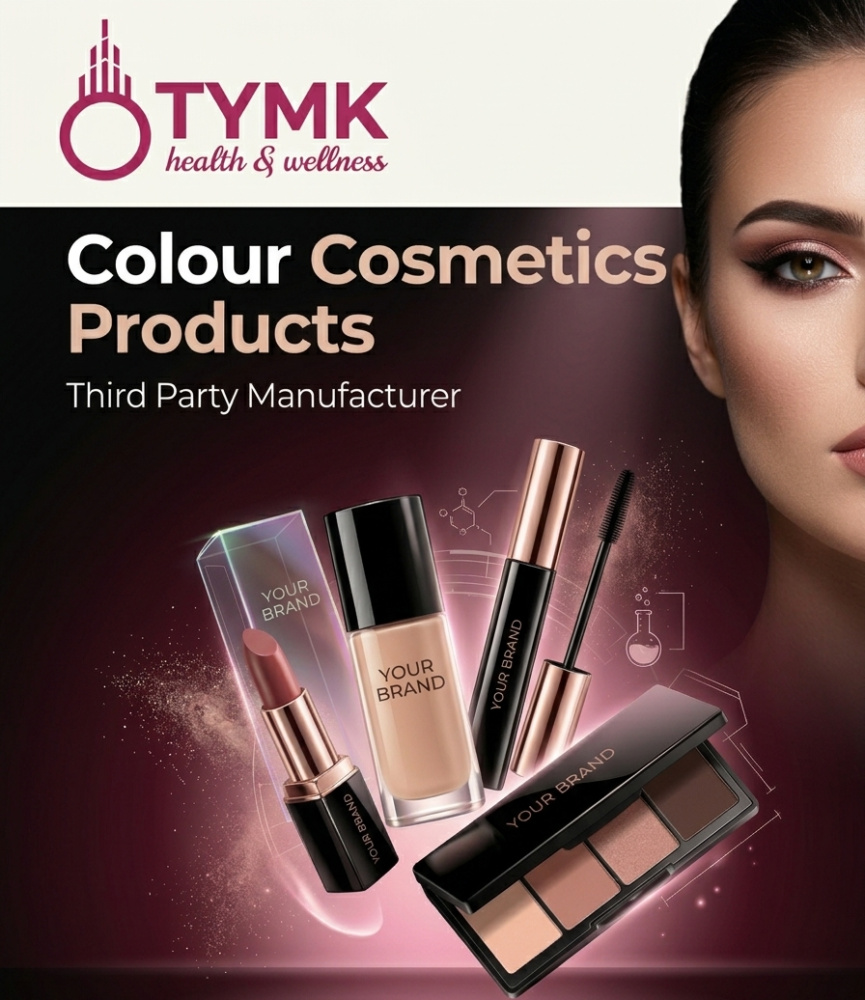
Colour Cosmetics Products Third Party Manufacturer
Learn how a Colour Cosmetics Products Third Party Manufacturer helps brands launch makeup products with lower investment and faster production support.
Colour Cosmetics Products Third Party Manufacturer
Table of Contents
- Introduction
- Understanding Third-Party Cosmetic Manufacturing
- Why Cosmetic Brands Use This Model
- How the Manufacturing Process Happens
- Popular Cosmetic Products You Can Launch
- Difference Between OEM, White Label & Third Party Manufacturing
- Who Can Start a Cosmetic Brand?
- A Real Market Example
- Important Things to Check Before Choosing a Manufacturer
- Why Businesses Connect with TYMK
- Featured Snippet
- FAQs
- Conclusion
Introduction
A lot of people think building a cosmetic brand starts with a factory.
In reality, that is rarely how modern beauty businesses begin.
Today, many cosmetic brands — including small online brands — work with a Colour Cosmetics Products Third Party Manufacturer to launch products without handling production internally.
This approach saves time, lowers investment pressure, and allows businesses to focus on branding, marketing, and sales growth instead of machinery and factory operations.
A few years back, this model was mostly used by large companies. Now even startups, salon owners, influencers, and D2C brands are entering the cosmetic industry through third party manufacturing.
And honestly, it makes practical business sense.
What is a Colour Cosmetics Products Third Party Manufacturer?
A Colour Cosmetics Products Third Party Manufacturer is a company that manufactures cosmetic products for another brand.
The manufacturer handles production while the brand sells products under its own label.
The work usually includes:
- Formula development
- Product manufacturing
- Filling and packaging
- Label printing
- Quality checking
- Bulk production
For example, if someone wants to launch lipstick or compact powder under their own beauty brand, they can work with a third-party manufacturer instead of investing in a manufacturing setup.
The final product carries the client’s brand name, not the manufacturer’s.
Why Cosmetic Brands Use Third-Party Manufacturing
Most new cosmetic businesses face the same challenge.
They have product ideas, but the manufacturing setup becomes expensive and complicated.
Building a production facility involves:
| Requirement |
Challenge |
| Machinery |
High setup cost |
| Technical team |
Skilled manpower needed |
| Testing systems |
Compliance requirements |
| Packaging setup |
Additional investment |
| Raw material sourcing |
Time-consuming process |
This is why outsourced cosmetic production has become common.
Key Advantages
Lower Business Risk
Businesses avoid investing heavily in infrastructure during the start-up phase.
Faster Product Launch
Manufacturers already have systems in place, so products move faster to market.
Better Product Knowledge
Experienced manufacturers understand cosmetic texture, formulation balance, and packaging compatibility.
Easy Expansion
Brands can launch multiple categories together:
- Lipstick
- Kajal
- Foundation
- Herbal face products
- Shampoo
- Skin care cosmetics
Most people entering the cosmetic business underestimate how difficult consistency is. One bad batch can affect customer trust quickly.
That is why choosing the right manufacturing partner matters more than many founders realize.
How the Manufacturing Process Usually Works
The process is generally straightforward.
Step 1 — Product Discussion
The brand shares requirements like:
- Product type
- Ingredients
- Shade selection
- Quantity
- Packaging style
Some brands ask for herbal formulas while others focus on premium makeup products.
Step 2 — Sample Creation
Manufacturers prepare samples before production starts.
This allows the client to review:
- Texture
- Fragrance
- Pigmentation
- Finish quality
- Product feel
Small changes often happen during this stage.
Step 3 — Packaging Selection
Packaging is finalized based on branding needs.
| Packaging Type |
Example |
| Tubes |
Cream products |
| Bottles |
Serum & liquid makeup |
| Cartons |
Retail packaging |
| Printed Labels |
Brand identity |
Step 4 — Production
After approvals, bulk manufacturing begins.
Quality checks are done during production to maintain product consistency.
Step 5 — Dispatch
Products are packed and delivered with the client’s branding.
Popular Cosmetic Products You Can Launch
An experienced manufacturer can support several product categories together.
| Segment |
Products |
| Lip Products |
Lipstick, gloss, balm |
| Face Makeup |
Foundation, compact, primer |
| Eye Makeup |
Kajal, eyeliner, mascara |
| Skin Care |
Face serum, cream, cleanser |
| Hair Care |
Shampoo, conditioner |
| Herbal Cosmetics |
Herbal kajal, herbal creams |
Many businesses also expand into:
- White Label Cosmetic Manufacturer
- Herbal Products Contract Manufacturer
- Hair Care Products Manufacturer
- Perfume White Label Manufacturer
- Face Serum Contract Manufacturer
This helps brands create a wider beauty portfolio.
Difference Between OEM, White Label & Third Party Manufacturing
These terms are often mixed together, but they are slightly different.
| Model |
Meaning |
Customization |
| White Label |
Ready product with branding |
Low |
| Private Label |
Existing formula with modifications |
Medium |
| OEM Cosmetics |
Fully customized formula |
High |
| Third-Party Manufacturing |
Outsourced production support |
Flexible |
Businesses looking for faster launches usually choose white-label products.
Brands focused on long-term differentiation often move toward OEM cosmetics later.
Who Can Start a Cosmetic Brand?
Third-party manufacturing is not limited to large companies.
Common Business Types
Startup Beauty Brands
Low investment makes market entry easier.
Salon Businesses
Salons often launch private cosmetic products for loyal customers.
Influencers & Creators
Beauty creators use personal branding to sell makeup lines online.
MLM Businesses
Many businesses searching for MLM Product Manufacturer or Direct Selling Product Manufacturer services use outsourced production systems.
Herbal & Ayurvedic Brands
Herbal product businesses benefit from flexible formulation options.
A Real Market Example
A small online beauty seller from Ahmedabad wanted to launch herbal lip products.
At first, they considered importing ready-made products from another country. But delivery timelines were inconsistent, and packaging quality varied between batches.
Later, they partnered with a domestic Colour Cosmetics Products third-party manufacturer.
The difference became noticeable within months.
| Earlier Issue |
After Manufacturing Partnership |
| Import delays |
Faster production |
| Packaging inconsistency |
Better branding control |
| Large minimum orders |
Flexible quantities |
| Communication gaps |
Easier coordination |
Eventually, the business expanded into skincare and shampoo products as well.
This type of growth path is becoming increasingly common in India’s cosmetic market.
Important Things to Check Before Choosing a Manufacturer
Not every manufacturer offers the same quality level.
Before finalizing any partnership, businesses should review several factors carefully.
| Factor |
Importance |
| Product testing |
Better safety standards |
| Manufacturing experience |
Stable production quality |
| MOQ flexibility |
Startup-friendly support |
| Packaging capability |
Stronger branding |
| Delivery timelines |
Faster launches |
| Product categories |
Easier future expansion |
Pricing matters, but reliability matters more in the long run.
A cheaper product with inconsistent quality can damage customer trust very quickly.
Why Businesses Connect with TYMK
TYMK works with brands across cosmetics, skincare, wellness, herbal products, and personal care categories.
Businesses often prefer TYMK because of:
- Product customization support
- Packaging flexibility
- Multi-category manufacturing
- OEM and white label solutions
- Scalable production capability
- Startup-friendly operations
The company also supports categories like:
- White Label Cosmetic Manufacturer
- Customised Cosmetic Manufacturer
- OEM Colour Cosmetics
- Shampoo White Label Manufacturer
- Herbal Products White Label Manufacturer
- Face Serum White Label Manufacturer
This allows businesses to manage multiple product categories through one manufacturing partner instead of handling separate vendors.
A Colour Cosmetics Products Third Party Manufacturer produces cosmetic and makeup products for brands under customized packaging and labeling requirements. These manufacturers help businesses launch products like lipstick, kajal, foundation, and skincare cosmetics without building their own manufacturing facility. TYMK supports cosmetic brands with scalable third-party manufacturing solutions.
FAQs
What is a Colour Cosmetics Products Third Party Manufacturer?
It is a company that manufactures cosmetic products for businesses that sell products under their own brand name.
Is third-party cosmetic manufacturing suitable for startups?
Yes. It lowers manufacturing investment and helps startups launch products faster.
Which products can be manufactured?
Products include lipstick, kajal, serum, compact powder, shampoo, foundation, and herbal cosmetics.
What is OEM cosmetic manufacturing?
OEM manufacturing involves creating customized cosmetic formulations for a specific brand.
Can herbal cosmetic products also be manufactured?
Yes. Many manufacturers provide herbal and Ayurvedic cosmetic formulations.
How can businesses connect with TYMK?
Businesses can contact TYMK for cosmetic manufacturing consultation, packaging support, and product development.
For cosmetic regulations and public health guidance:
Ministry of Health & Family Welfare, India
Conclusion
Working with a reliable Colour Cosmetics Products third-party manufacturer helps businesses enter the beauty industry with lower operational pressure and faster production support.
Instead of investing heavily in manufacturing infrastructure, brands can focus on product positioning, marketing, customer experience, and business growth.
For businesses planning to launch or expand cosmetic product categories, companies like TYMK provide flexible manufacturing support across cosmetics, skincare, herbal, and personal care segments.