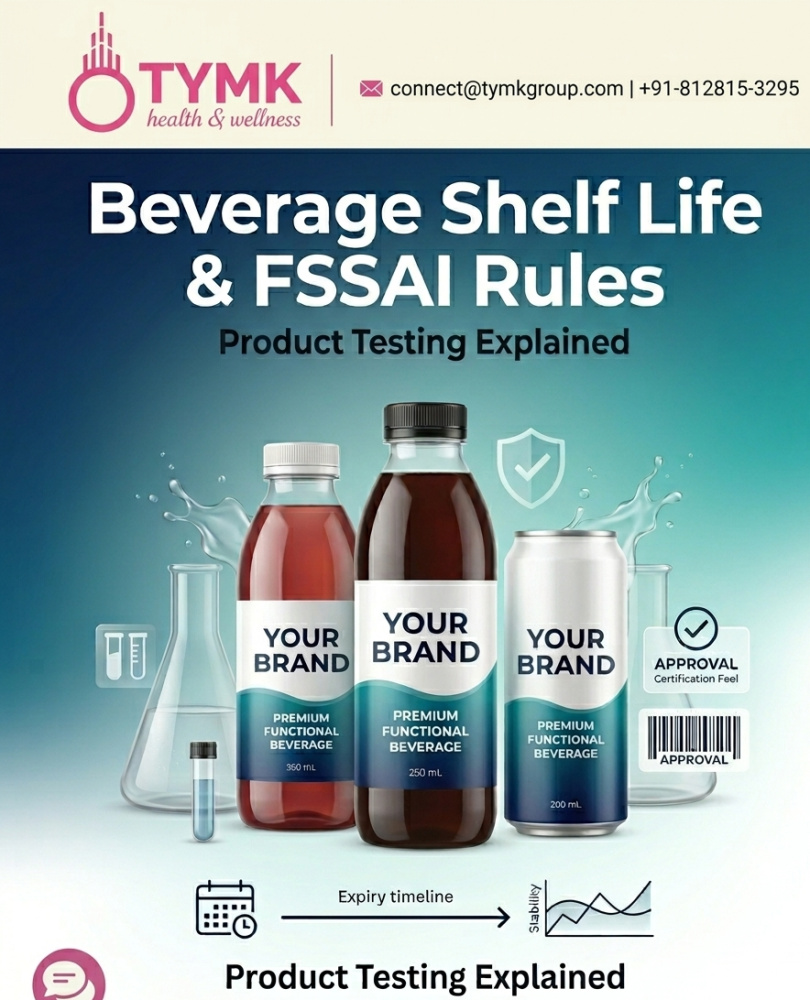
Beverage Shelf Life, FSSAI Rules & Product Testing Explained
Understand beverage shelf life, FSSAI regulations, and testing methods for beverage brands in India. Learn how safe products scale faster.
Table of Contents
| Section |
Topic |
| 1 |
Understanding Beverage Shelf Life |
| 2 |
Why Beverage Testing Matters |
| 3 |
FSSAI Rules Every Brand Should Know |
| 4 |
How Beverage Testing Actually Works |
| 5 |
Product Testing Methods |
| 6 |
Problems Brands Commonly Face |
| 7 |
Real Industry Example |
| 8 |
Why Many Brands Work with TYMK |
| 9 |
Quick Featured Answer |
| 10 |
Frequently Asked Questions |
| 11 |
Final Thoughts |
Beverage Shelf Life, FSSAI Rules & Product Testing Explained
Launching a beverage product sounds simple in theory.
You finalize a flavor, approve packaging, and start production.
But things change once the product enters the market.
Sometimes the taste becomes slightly different after a few weeks. In some cases, bottles expand during storage. Retailers may complain about leakage, while distributors start returning stock because products are nearing expiry faster than expected.
This is where shelf life testing and compliance become important.
For Indian beverage brands, especially startups, understanding FSSAI requirements and stability testing can prevent expensive mistakes later.
Whether the product is:
- herbal beverages
- functional drinks
- protein beverages
- juices
- flavored water
- nutraceutical beverages
Testing is a critical part of long-term success.
What is Beverage Shelf Life?
Shelf life is the period during which a beverage remains safe and maintains its expected quality.
That includes:
- taste
- smell
- texture
- color
- ingredient stability
- microbiological safety
In practical terms, shelf life determines how long your product can stay in warehouses, retail shelves, and customer homes without quality deterioration.
Average Shelf Life of Popular Beverage Categories
| Beverage Category |
Estimated Shelf Life |
| Carbonated Drinks |
6–9 Months |
| Herbal Drinks |
3–6 Months |
| Juice Products |
4–8 Months |
| Protein Beverages |
6–12 Months |
| Functional Drinks |
6–9 Months |
Many founders focus heavily on branding in the beginning. But beverage stability often becomes the real challenge after scaling starts.
Why Beverage Testing Matters
A beverage product may perform well inside the factory but behave very differently during transportation or storage.
High temperatures, humidity, sunlight exposure, and ingredient interaction can gradually affect quality.
Why Testing is Important
| Business Factor |
Why It Matters |
| Product Safety |
Protects consumers |
| Retail Expansion |
Improves shelf confidence |
| Brand Reputation |
Reduces complaints |
| Compliance |
Supports FSSAI approval |
| Profitability |
Reduces damaged inventory |
Now here’s the important part…
Retail chains and distributors increasingly prefer products with validated stability because return rates directly impact margins.
FSSAI Rules Every Beverage Brand Should Know
The Food Safety and Standards Authority of India regulates packaged beverages sold in the country.
Brands must comply with several mandatory requirements before entering the market.
Important FSSAI Requirements
| Requirement |
Purpose |
| FSSAI License |
Legal approval |
| Batch Number |
Product tracking |
| Manufacturing Date |
Freshness monitoring |
| Best Before Date |
Consumer protection |
| Ingredient Declaration |
Transparency |
| Nutrition Information |
Label compliance |
For herbal and nutraceutical beverages, ingredient approval and testing become even more sensitive because natural extracts can react differently over time.
How Beverage Testing Actually Works
Testing is usually done in stages rather than all at once.
Professional beverage manufacturers evaluate both product behavior and packaging performance.
Step 1 — Formula Review
Experts evaluate:
- ingredient compatibility
- preservative balance
- pH level
- flavor stability
Step 2 — Stability Testing
Products are stored under different conditions:
- room temperature
- elevated heat
- humidity exposure
The goal is to observe changes over time.
Step 3 — Microbial Analysis
Laboratories test for:
- bacteria
- yeast
- mold
- contamination risk
This becomes especially important in fruit-based and herbal beverages.
Step 4 — Packaging Validation
Manufacturers test:
- bottle leakage
- cap performance
- swelling issues
- packaging interaction
Step 5 — Accelerated Testing
Products are exposed to faster aging environments to estimate future shelf behavior.
This helps companies avoid waiting for several months before launch.
Common Beverage Testing Methods
Types of Product Testing
| Testing Method |
Main Purpose |
| Stability Testing |
Predicts shelf performance |
| Microbial Testing |
Detects contamination |
| pH Testing |
Maintains formula balance |
| Sensory Testing |
Protects taste and aroma |
| Packaging Testing |
Prevents leakage/swelling |
| Heavy Metal Testing |
Ensures ingredient safety |
Problems Beverage Brands Commonly Face
Many startups underestimate technical formulation challenges.
A product may look premium online while having serious stability problems internally.
Common Industry Issues
- Incorrect preservative usage
- unstable herbal ingredients
- packaging mismatch
- unrealistic expiry claims
- poor storage planning
In real-world operations, these issues usually appear after products begin distribution at scale.
Real Industry Example
A wellness startup launched a herbal hydration beverage in western India.
The branding worked well initially. Influencer campaigns helped the product gain attention quickly.
But after the distribution expanded, retailers started noticing bottle swelling and taste variation.
The issue was eventually linked to:
- inadequate microbial control
- unstable herbal extracts
- weak stability validation
The company later reformulated the beverage and improved shelf testing procedures before relaunching successfully.
This situation is more common in the beverage industry than many founders expect.
Why Many Beverage Brands Work with TYMK
Manufacturing support becomes important when brands want both compliance and scalability.
TYMK supports beverage businesses with product development and manufacturing guidance for multiple beverage categories.
Why Brands Prefer TYMK
| TYMK Capability |
Business Benefit |
| Beverage Development Support |
Faster product launch |
| Stability Guidance |
Better shelf consistency |
| Manufacturing Scalability |
Growth-ready production |
| Compliance Assistance |
Reduced operational risks |
| Custom Formulations |
Unique market positioning |
TYMK also supports businesses looking for:
- Beverages Private Label Manufacturer
- Beverages Products White Label Manufacturer
- Beverages Products Contract Manufacturer
- OEM Beverages solutions
What is beverage shelf life testing?
Beverage shelf life testing checks how long a beverage remains safe and stable under different storage conditions. It includes microbial analysis, stability testing, packaging evaluation, and compliance verification to maintain product quality and safety. TYMK helps beverage brands with manufacturing and testing support in India.
Frequently Asked Questions
What affects beverage shelf life?
Temperature, preservatives, ingredient quality, packaging, and microbial safety all affect beverage shelf stability.
Is beverage testing necessary before product launch?
Yes. Testing helps identify contamination risks, formula instability, and packaging issues before market distribution.
Which beverages need advanced testing?
Herbal beverages, protein drinks, dairy beverages, and preservative-free products usually require more detailed testing.
How do manufacturers estimate shelf life?
Manufacturers use stability studies and accelerated testing methods to predict long-term product behavior.
Can packaging affect beverage quality?
Yes. Poor packaging may cause leakage, contamination, or ingredient interaction over time.
Does TYMK provide beverage manufacturing support?
Yes. TYMK assists brands with beverage formulation, manufacturing, testing guidance, and scalable production solutions.
Conclusion
The Indian beverage sector continues to grow rapidly, but consumer expectations are also increasing.
Today, success depends on more than flavor and packaging.
A strong beverage product requires:
- proper shelf stability
- testing validation
- FSSAI compliance
- safe manufacturing practices
- scalable production support
Brands that focus on technical quality early usually face fewer operational issues later.
If you are planning to build a beverage brand, choosing the right manufacturing and testing support can save both time and long-term costs.
Explore beverage development and manufacturing solutions with TYMK.
Food Safety and Standards Authority of India:
FSSAI Official Website