Baby Care Products White Label Manufacturer Guide
A complete guide to Baby Care Products White Label Manufacturer models, process, benefits, and business opportunities. Learn how brands scale quickly using OEM solutions. Understand manufacturing, compliance, and market strategy in one place.
Baby Care Products White Label Manufacturer Guide
Baby Care Products White Label Manufacturer guide explaining process, benefits, and real-world brand scaling strategies using OEM and private label models.
Introduction
Most baby care brands don’t actually start with a factory. That’s the part people usually misunderstand.
In reality, the first version of many successful baby shampoo or lotion brands is not “created from scratch” — it’s selected, adjusted, and rebranded through a Baby Care Products White Label Manufacturer setup.
And once you see how the system works, it becomes clear why so many new brands prefer it. Speed matters. Compliance matters even more. But capital efficiency is usually the deciding factor.
This is where manufacturing partners quietly shape entire beauty and personal care markets without ever being visible to end customers.
What this model actually means
A white-label baby care manufacturer already has formulations prepared — tested, stabilized, and production-ready.
Brands don’t build chemistry labs or R&D teams. They pick a base product and apply their own identity on top of it.
So instead of “creating” a baby lotion, the brand is essentially deciding:
- packaging direction
- branding identity
- positioning in the market
Everything else is already handled upstream.
This is also why terms like OEM Baby Care Products, Private Label Baby Care Manufacturer, and Contract Manufacturing often overlap in real discussions — even though they are slightly different on paper.
Why brands depend on this system
If you speak to founders in personal care, one pattern appears repeatedly: time kills more ideas than competition does.
White label manufacturing solves three practical problems:
- Product development delays disappear
- Regulatory groundwork is already completed
- Initial investment risk is significantly lower
There is also another factor people rarely mention: iteration speed.
If a product doesn’t perform in the market, brands can pivot quickly without restarting production infrastructure.
That flexibility is often more valuable than ownership of the formulation itself in early stages.
How it works in a real business flow
The actual process is less dramatic than most people expect.
A typical flow looks like this:
A brand reviews existing baby care formulations — shampoos, lotions, oils. Nothing is theoretical; everything already exists in production form.
Then branding decisions begin. This is where most of the “identity” work happens.
After that, compliance checks are verified again under the brand name, even though the base formulation is already approved.
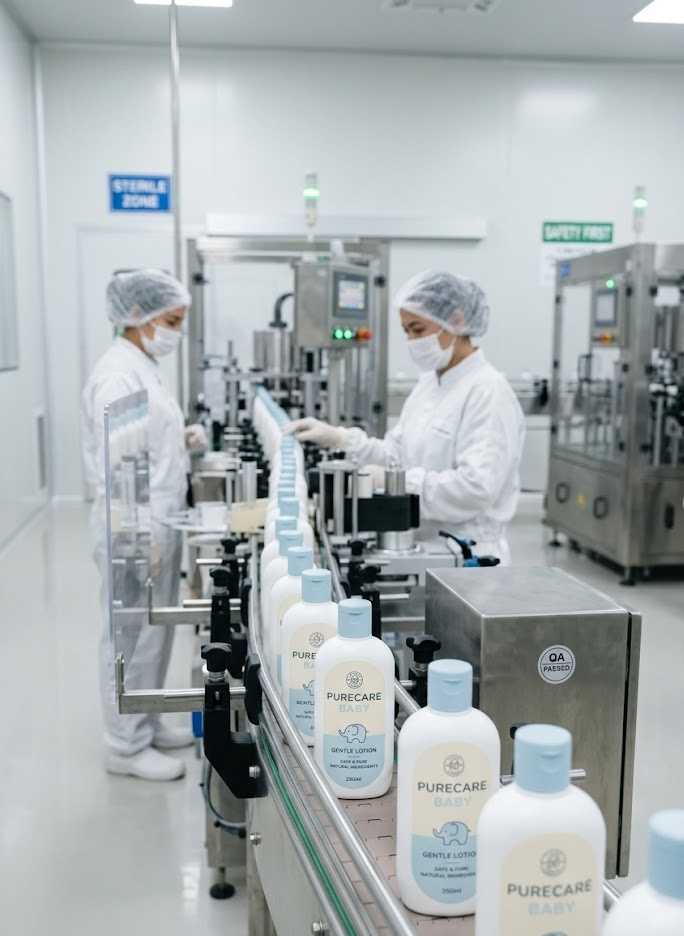
Production follows in batches. Packaging is applied last, not first.
And finally, the product enters distribution channels — e-commerce, retail, or export.
What looks like a product launch is actually a coordination exercise between formulation stability and brand positioning.
When this model makes sense
Not every stage of business needs white label, but early and scaling phases often do.
It fits best when:
- You want to enter the market quickly
- You don’t want to invest in manufacturing infrastructure
- You are testing multiple product categories
- You are building a portfolio brand, not a single product
Baby care is especially sensitive here because consumer trust is extremely high-risk. Parents don’t experiment easily. So consistency matters more than experimentation.
Who actually uses it
This model is not limited to startups.
In practice, it is used by:
- new D2C baby care brands
- pharmacy distribution networks
- exporters entering new regions
- MLM and direct-selling companies
- Cosmetic expansion brands adding baby lines
Different business models, same backend logic.
White label vs other manufacturing models
There’s often confusion between white label, private label, and OEM.
The difference is mostly in the control level:
White label is closest to “ready-made with branding.”
Private label introduces partial customization.
OEM allows deeper formulation involvement.
Contract manufacturing sits at the top in complexity and control.
Most brands actually move through these stages rather than choosing one forever.
Real-world scenario (how it plays out)
A small skincare startup wants to launch a baby lotion in India.
If they try building everything internally, they need chemists, lab testing cycles, regulatory approval, and production setup. That can take over a year.
Instead, they work with a Baby Care Products White Label Manufacturer, select an existing formula, customize packaging, and launch in a fraction of that time.
The trade-off is simple: less control, faster entry.
Most early-stage brands accept that trade without hesitation.
About TYMK
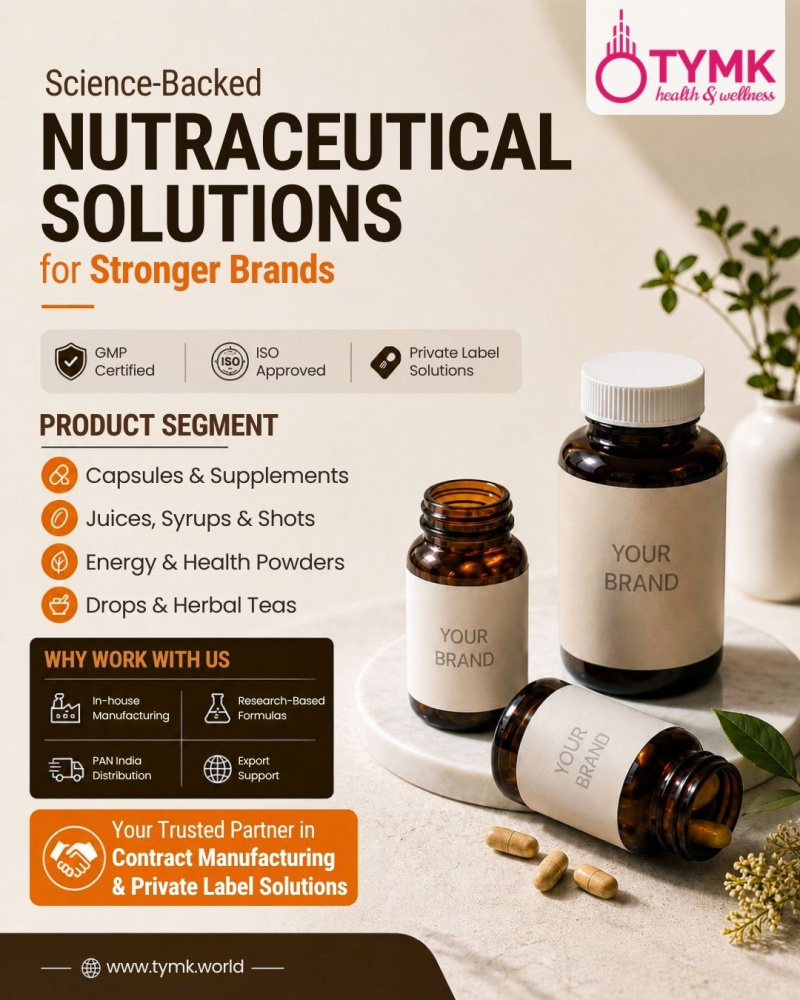
In this ecosystem, companies like TYMK operate as backend manufacturing partners for personal care and cosmetic categories.
The role is not visible to end consumers, but structurally important.
They typically handle:
- formulation-ready product supply
- OEM and white label production
- scalable batch manufacturing
- compliance-aligned production systems
For brands, this removes operational friction and shifts focus toward distribution and positioning — where most competition actually happens.
Featured Snippet (Google-ready)
A Baby Care Products White Label Manufacturer provides pre-formulated baby care products that brands can rebrand and sell. It reduces production time, lowers setup cost, ensures compliance, and enables fast market entry without building manufacturing infrastructure.
FAQs
What is a baby care white-label manufacturer?
It is a company that supplies ready-made baby care products that can be branded and sold by other companies.
Is white label safe for baby products?
Yes, products are usually tested and manufactured under regulatory cosmetic safety standards before branding.
What is the difference between white label and private label?
White label uses existing formulations, while private label allows more customization.
Can small businesses use this model?
Yes, it is commonly used by startups entering the baby care market.
Which products are usually offered?
Shampoos, lotions, oils, creams, powders, and mild skincare products.
Conclusion
White label manufacturing is less about production and more about timing.
It allows brands to enter a competitive market without waiting for perfect infrastructure. And in baby care, where trust and speed both matter, that balance is often what determines survival in the first year.
For structured manufacturing support, partners like TYMK remain part of the backend ecosystem, enabling these launches.