TYMK Blog

Baby Care Products Contract Manufacturer Guide for New Brands

<p>Baby Care Products Contract Manufacturer helps brands produce safe, compliant baby care items like lotions, shampoos, and oils without owning a factory.</p><p> It covers formulation, production, packaging, and quality control under OEM/white label models.</p><p> This enables faster market entry and scalable FMCG brand growth with lower investment risk.</p><p><br></p>

19 May 2026 4 mins read

Baby Care Products Contract Manufacturer Guide for New Brands


Understand baby care contract manufacturing, OEM models, and how brands launch safely without factories in the FMCG industry.


Introduction

Most people assume starting a baby care brand is just about packaging and selling. In reality, the hardest part is not marketing—it is manufacturing that meets safety expectations.

Baby skin is sensitive, so even small formulation mistakes can create serious issues. This is why many new brands avoid building factories altogether.

Instead, they rely on a Baby Care Products Contract Manufacturer, where production, formulation, and compliance are already handled.

It’s not just a cost-saving decision anymore. It has become a practical entry strategy in the FMCG space.


What is a Baby Care Products Contract Manufacturer?

A Baby Care Products Contract Manufacturer is a company that produces baby care items for other brands under their own label.

The brand owns the identity, while the manufacturer handles the actual production work.

Typical products include:

  • Baby shampoo
  • Baby lotion
  • Baby massage oil
  • Baby powder
  • Herbal baby skincare items

You may also hear terms like OEM, white label, or private label manufacturing. In most cases, they overlap in how they function, even if the naming is different.


Why this Model Matters (Real Market Logic)

In real business conditions, setting up a baby care production unit is expensive and slow. You need approvals, machinery, chemists, and quality systems.

Most startups don’t start there.

Instead, contract manufacturing removes that barrier. It allows a brand to focus on distribution and customer building first.

Another overlooked point—regulations in baby care are strict. One compliance issue can delay an entire product launch. Manufacturers already operating in this system reduce that risk.


How the Process Actually Works

The process is not complicated, but it is structured.

First, the brand shares what they want—say, a herbal baby lotion.

Then the manufacturer develops a formula. This is where experience matters because baby care cannot be treated like regular skincare.

Samples are created. Adjustments happen. Sometimes multiple rounds.

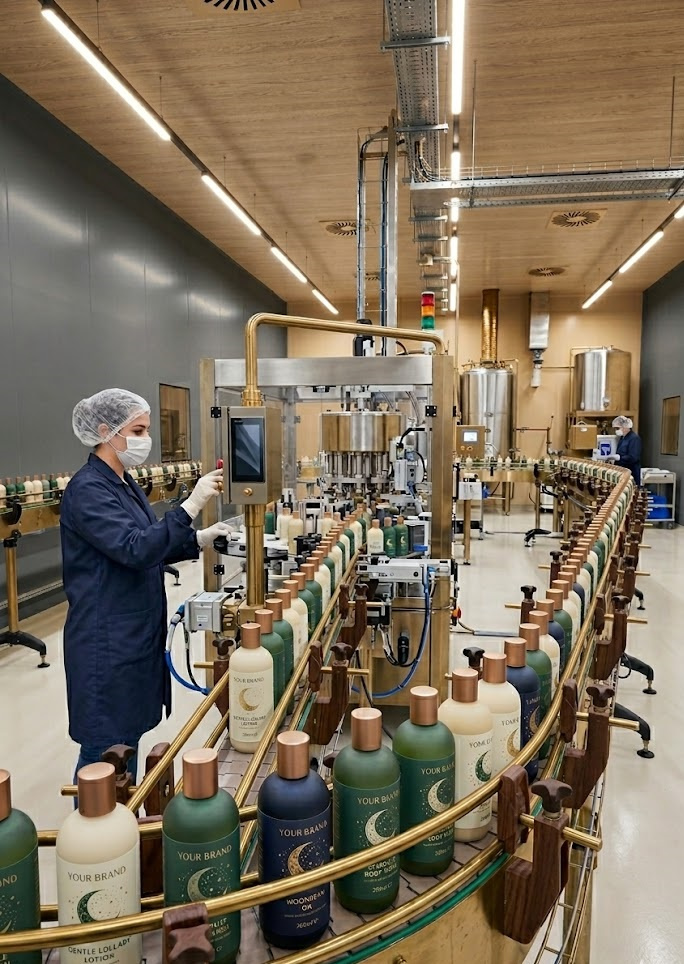
Once approved, production begins in batches. Packaging is added at the end stage with branding.

Finally, the product is ready for market distribution.

Nothing unusual, but each step is quality-controlled.


When Brands Usually Choose This

Most brands don’t wake up and decide to manufacture overnight. It happens at specific points:

  • When they want to launch quickly
  • When investment is limited
  • When scaling becomes difficult
  • When entering baby care for the first time
  • When expanding an existing FMCG portfolio

It is often a “growth stage decision,” not an early experiment.


Who Uses This Model

You’ll find this model used by:

  • New FMCG startups
  • Herbal product brands
  • MLM and direct selling companies
  • Online marketplace sellers
  • Cosmetic entrepreneurs expanding into baby care

Even established brands sometimes outsource production instead of expanding infrastructure.


Comparison View (Simple Decision Guide)

Model Investment Speed Flexibility Control
OEM Medium Medium High High
White Label Low Fast Low Medium
Private Label Medium Medium Medium High
Contract Manufacturing Optimized Fast High Balanced

No model is universally “best.” It depends on how fast and how customized your brand needs to be.


Brand Note (TYMK Context)

In manufacturing ecosystems, execution capability matters more than claims.

TYMK World operates in the cosmetic and personal care manufacturing space, covering categories like baby care, skincare, hair care, and wellness products.

TYMK World

The real value for brands usually comes from:

  • Stable production systems
  • Category experience
  • Ability to scale batches
  • Product customization support

For most small and mid-size brands, this removes the operational burden of running production internally.


Featured Snippet (Direct Answer)

A Baby Care Products Contract Manufacturer produces baby care items like lotions, shampoos, and oils for brands under their label. It manages formulation, production, packaging, and compliance so brands can launch products without owning a factory.


FAQs

What does a baby care contract manufacturer do?

They handle production, formulation, and packaging for baby care brands under private labels.

Is OEM the same as contract manufacturing?

OEM is a type of contract manufacturing where products are made as per brand requirements.

Is this model good for new brands?

Yes, because it reduces setup cost and speeds up launch.

What products can be manufactured?

Baby lotions, shampoos, oils, powders, and herbal skincare products.

Why do brands use it?

To reduce cost, avoid infrastructure, and scale faster.


Conclusion

Baby care contract manufacturing is less about outsourcing and more about reducing entry friction. It allows brands to focus on selling while production is handled by specialized systems.

For most new entrants in FMCG, it is not just an option—it is often the practical starting point.


Recent Posts

call to +918128153295
sent message to whatsapp
contact now