
Ayurvedic White Label Manufacturer (Practical Guide)
Ayurvedic Products White Label Manufacturer helps brands launch ready-made herbal products under their own label without setting up a factory. It reduces cost, saves time, and ensures compliant production. Ideal for startups and growing wellness businesses entering the Ayurvedic market quickly.
Ayurvedic White Label Manufacturer (Practical Guide)
Learn how Ayurvedic white label manufacturing works, why brands use it, and how it helps launch herbal products faster with lower setup costs.
Introduction
Most people think starting an Ayurvedic brand is about having a good product idea. In reality, the hardest part is production—getting formulations right, finding a compliant facility, handling packaging, and managing approvals.
That’s usually where the plan slows down or stops completely.
So instead of building everything from scratch, many brands quietly take a different route: they work with an Ayurvedic white-label manufacturer, use existing formulations, and focus only on branding and sales.
It’s not new. It’s just widely used but not always talked about openly.
What this actually means
At its core, white label manufacturing is simple.
A manufacturer already produces Ayurvedic products—shampoos, oils, creams, supplements—using tested formulations. These products are then given to different companies that sell them under their own brand name.
Nothing complicated on paper:
- Product already exists
- Brand name changes
- Packaging changes
- Market launch happens faster
The same product can appear under multiple brand identities.
Why brands choose this route
There’s a practical reason this model keeps growing: speed.
Building a manufacturing setup takes time, money, and technical knowledge. Most new businesses don’t have all three at once.
White label removes that friction.
What it solves:
- No factory investment in the early stage
- No long R&D cycles
- No regulatory setup from zero
- Faster entry into online marketplaces
- Easier testing of product-market fit
In simple terms, it lets a brand start operating without waiting years to become “fully ready.”
How the process usually works
It doesn’t feel very dramatic in real life. It’s mostly coordination.
- You choose a product range
- Basic customisation happens (packaging, label, fragrance if allowed)
- Compliance and internal checks are done
- Manufacturing is handled by the facility
- Final packaging is completed
- Products are shipped out for sale
That’s it. Most of the complexity stays on the manufacturer’s side.
When this model makes sense
Not every brand needs this setup, but it works well in a few cases:
- You want to launch quickly, not months later
- You’re testing a new product idea
- You don’t want to invest heavily up front
- You are building an online-first brand
- You want to expand product lines without infrastructure
It is often used as a “first step model” before scaling into more advanced manufacturing setups.
Who typically uses it
This model shows up across different types of businesses:
- Small wellness startups
- E-commerce sellers
- MLM / direct selling networks
- Export-focused herbal companies
- Beauty brands expanding their catalogue
The common factor is not size—it’s speed and flexibility.
Simple comparison view
| Model | Setup Cost | Speed | Custom Control |
|---|---|---|---|
| White Label | Low | Fast | Limited |
| OEM | Medium | Moderate | High |
| Contract Manufacturing | High | Slow | Very High |
White label usually sits at the entry point of the industry.
Brand mention
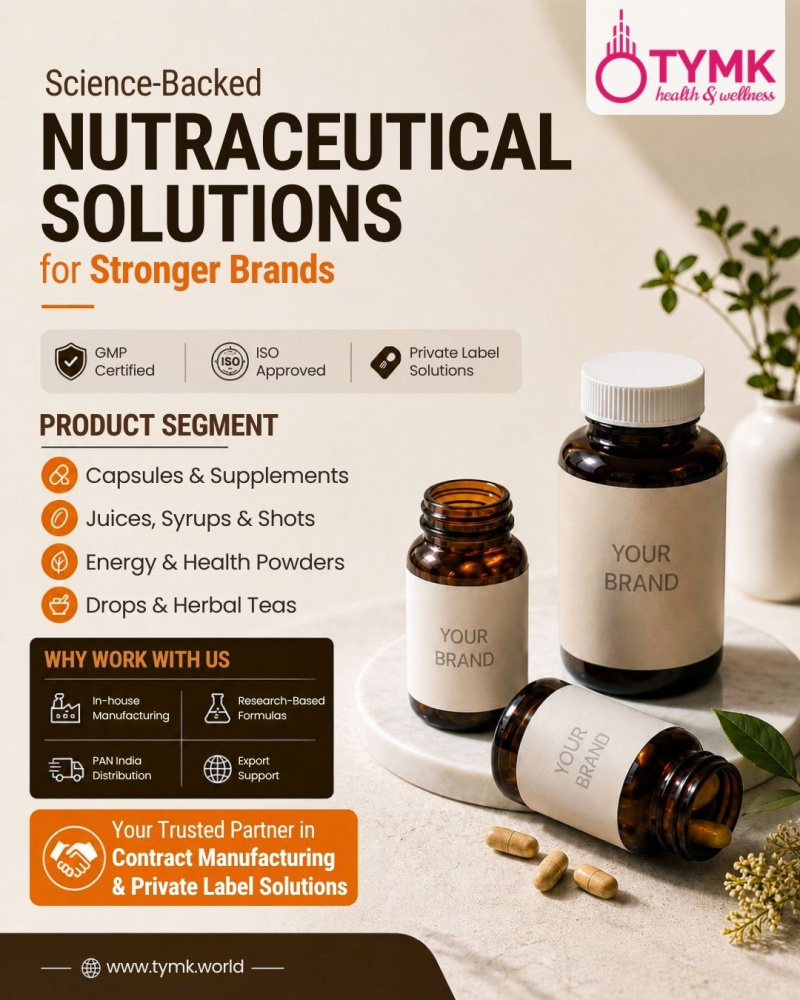
Manufacturing partners like TYMK Manufacturing Solutions operate in this ecosystem by supporting brands that don’t want to build production infrastructure internally.
In most cases, the real value is not just production—it’s consistency, compliance handling, and the ability to scale when demand increases.
Featured snippet (direct answer)
Ayurvedic white label manufacturing is a system where pre-developed herbal products are produced by a manufacturer and sold under different brand names. It helps businesses launch faster without setting up production facilities while ensuring compliance and scalable output.
A real-world example
A small Ayurvedic brand wanted to enter the hair oil segment but had no production setup.
Instead of delaying the launch, they selected an existing formulation through a white-label partner.
Within a few weeks:
- Packaging was designed
- The initial batch was produced
- Product listings went live online
The brand didn’t start with perfection—it started with availability. Improvement came later based on customer feedback.
FAQs
What is Ayurvedic white label manufacturing?
It is when ready-made Ayurvedic products are sold under a different brand name.
Is it suitable for new businesses?
Yes, especially for startups that want quick entry.
Does it reduce cost?
Significantly, since no factory setup is required.
Can products be customised?
Yes, but within limits depending on the manufacturer.
Is it commonly used in India?
Yes, especially in herbal, skincare, and wellness categories.
Conclusion
White label manufacturing is less about shortcuts and more about practicality. It removes operational friction so brands can enter the market sooner and refine their products based on real demand instead of assumptions.
For many businesses, it becomes the first workable step before scaling into full manufacturing control.