TYMK Blog

MOQ in Cosmetic Manufacturing Explained for New Brands in India

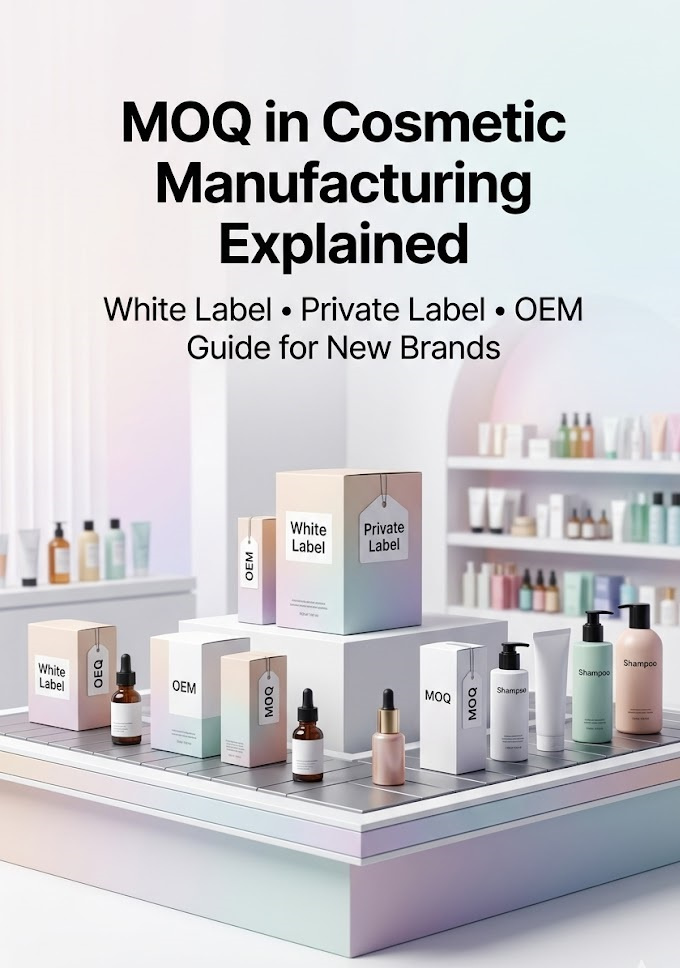
<p>This blog explains Minimum Order Quantity (MOQ) in cosmetic manufacturing, how it is calculated, and its impact on new brands. It helps startups understand white label, private label, and OEM production models with real industry insights.</p><p><br></p>


27 May 2026 5 mins read

MOQ in Cosmetic Manufacturing Explained for New Brands in India


Table of Contents

  1. Introduction
  2. What is MOQ
  3. Why MOQ Exists
  4. Importance for New Brands
  5. How MOQ is Calculated
  6. Real Startup Example
  7. Low MOQ vs High MOQ Strategy
  8. Manufacturing Models (Table)
  9. Common Mistakes
  10. Manufacturer Thinking
  11. Industry Trends
  12. TYMK.world Approach
  13. FAQ
  14. Conclusion

Introduction

Starting a cosmetic brand today looks easy from the outside. Branding tools, social media, and e-commerce platforms make it feel like anyone can launch a product quickly. But manufacturing works on a completely different system.

One of the first real barriers every founder faces is Minimum Order Quantity (MOQ).

Most beginners assume manufacturing works like retail shopping, where small quantities can be ordered freely. In reality, cosmetic production runs on batch-based industrial systems. Every production cycle includes fixed costs such as machine setup, raw material procurement, packaging coordination, and quality testing.

These costs remain constant whether production is small or large. Because of this structure, manufacturers define a minimum production requirement. MOQ is not a restriction—it is a production efficiency mechanism.


What is MOQ

MOQ (Minimum Order Quantity) refers to the smallest number of units a manufacturer produces in a single batch.

It is not fixed and varies depending on product type, formulation complexity, and packaging requirements. A white-label shampoo or face wash may start around 300–1000 units, while a customized serum or advanced skincare formulation may require 3000–10,000 units.

The difference comes from production complexity. Simple rinse-off products require less setup, while active-based formulations require stability testing, controlled processing, and higher quality validation.


Why MOQ Exists

MOQ exists because cosmetic manufacturing includes fixed production costs that do not change with volume.

Each batch requires machine cleaning, setup, calibration, and testing. These steps take time and resources regardless of output size. Raw materials are also purchased in bulk from suppliers who have their own minimum order requirements.

Packaging further increases MOQ because bottles, jars, caps, and labels are rarely produced in very small quantities. Even if the formulation is simple, packaging constraints increase the total production scale.

Quality testing is also done per batch, not per unit, making small production economically inefficient.


Importance for New Brands

MOQ plays a direct role in shaping how a cosmetic brand enters the market.

For new founders, MOQ determines how much capital is locked before sales even begin. A higher MOQ increases financial risk, while a lower MOQ reduces risk but may slightly increase per-unit cost.

In real terms, MOQ defines whether a brand is still in the experimentation phase or moving toward scaling. Most successful cosmetic brands begin with small production runs, validate demand, and then scale gradually instead of committing large budgets upfront.


How MOQ is Calculated

MOQ is not randomly defined. It is derived from production economics and operational structure.

Raw materials are purchased in bulk quantities, as suppliers do not provide ingredients in small retail amounts. Machine setup adds another fixed cost because every batch requires cleaning, calibration, and testing.

Packaging suppliers also define minimum order quantities for bottles, caps, and labels. Even if product formulation is simple, packaging alone can determine the overall MOQ.

Finally, compliance and quality testing are applied per batch. These combined factors create a natural minimum production threshold.


Real Startup Example

A skincare founder initially planned to launch with 100 units to test the market.

However, manufacturers quoted 3000 units MOQ due to packaging and production setup requirements.

Instead of stopping, she shifted strategy and started with a white-label base formulation using a pilot batch of 500 units.

After launching on Instagram and Shopify, she identified that one product variant performed significantly better than others.

She then scaled only that winning product in a higher MOQ batch.

This reflects an important reality: MOQ is not a barrier, but a phased growth system based on real market validation.


Low MOQ vs High MOQ Strategy

Low MOQ is most suitable during early-stage validation when the goal is to test demand, pricing, and customer response.

High MOQ becomes relevant when demand is stable and predictable. At this stage, production efficiency becomes more important than flexibility, and larger batches reduce per-unit cost significantly.

In simple terms, low MOQ is for testing, and high MOQ is for scaling.


Manufacturing Models (Comparison Table)

Model MOQ Customization Best For
White Label Low Minimal Beginners
Private Label Medium Moderate Growing brands
OEM High Full Established brands

White label is the easiest entry point. Private label offers moderate customization, while OEM involves full product development and higher investment.


Common Mistakes

Many founders focus only on per-unit pricing without considering the total MOQ investment. Lower pricing often comes with higher batch requirements, increasing overall financial risk.

Another common mistake is ignoring the packaging MOQ. Even if the product MOQ is negotiated, packaging suppliers often have separate minimum order requirements.

Some brands also skip demand validation and invest heavily in inventory before understanding the real market response. In cosmetics, demand must be tested before scaling.


Manufacturer Thinking

Manufacturers do not use MOQ as a barrier for startups. MOQ exists because production operates in cycles.

Machines, labor, and raw materials are planned in bulk batches. If production volume is too low, efficiency drops and cost increases for everyone involved.

Understanding this helps brands align expectations with manufacturing reality.


Industry Trends

The cosmetic industry is gradually shifting toward more flexible MOQ models due to the rise of D2C brands, influencer-led launches, and niche skincare products.

Digital forecasting and demand prediction tools are also improving production efficiency, which may gradually reduce MOQ pressure in the future.


TYMK.world Approach

At TYMK.world, manufacturing is structured around brand growth stages rather than rigid production rules.

Instead of forcing startups into large inventory commitments, flexible MOQ models are used for testing, validation, and scaling phases.

This allows founders to reduce early financial risk and make decisions based on real market performance instead of assumptions.


FAQ

What is MOQ in cosmetic manufacturing?

MOQ is the minimum number of units required per production batch based on the manufacturing cost structure.

Why is MOQ needed?

Because production involves fixed costs like setup, raw materials, packaging, and testing.

Can startups start with low MOQ?

Yes, white-label and private-label models often support low MOQ options.

Is low MOQ always better?

Not always. It reduces risk but may increase per-unit cost.

What is better for beginners?

White label is better for beginners, OEM is better for scaling brands.


Conclusion

MOQ is not a limitation. It is a structural part of cosmetic manufacturing economics.

Brands that understand MOQ properly can reduce risk, validate products faster, and scale in a controlled and sustainable way without unnecessary capital lock-in.


Recent Posts

call to +918128153295
sent message to whatsapp
contact now