How Cosmetic Manufacturing Pricing Actually Works in India
<p>This article explains how cosmetic manufacturing pricing actually works in India, including real cost drivers like MOQ, formulation, packaging, OEM/private label models, and industry logic behind pricing. Private Label Cosmetics, manufacturing in India</p><p><br></p>
How Cosmetic Manufacturing Pricing Actually Works in India
Introduction
Most people entering the beauty or skincare business assume cosmetic manufacturing in India works like a fixed-rate service. You ask for a product, and you get a price. But in reality, pricing is far more layered and dynamic.
Two brands can request the same “face serum” and still receive completely different pricing structures. One may pay ₹90 per unit, while another ends up at ₹220 or more. The difference is not random—it comes from formulation decisions, packaging choices, order quantity, and manufacturing model.
In real-world terms, cosmetic manufacturing pricing is not a single number. It is a combination of chemistry, compliance, production scale, and business strategy. Understanding this system is what separates profitable brands from those that struggle with margins in the first six months.
Quick Summary (Featured Snippet Style)
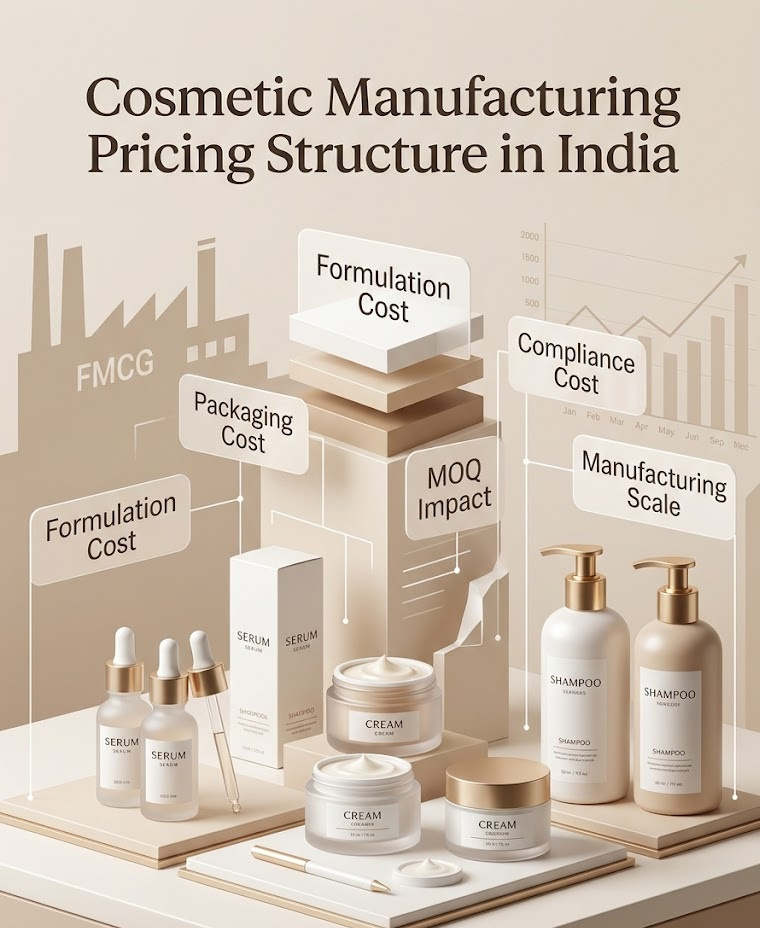
Cosmetic manufacturing pricing in India is determined by formulation cost, packaging type, MOQ, manufacturing model (OEM/private label/white label), compliance requirements, and production scale. Larger volumes reduce cost per unit, while customization increases pricing.
Market Overview
India’s cosmetic manufacturing industry has evolved rapidly due to the rise of D2C brands, influencer-led skincare labels, and herbal wellness demand. Earlier, manufacturing was limited to large FMCG companies, but today even small startups can launch their own beauty brand using OEM or private label systems.
This shift has made India a strong global hub for skincare, haircare, herbal cosmetics, and even nutraceutical beauty products. Manufacturers like Tymk World play a key role in supporting startups by offering scalable production models and flexible branding options.
However, with this opportunity comes confusion—especially around pricing. Many new founders underestimate how deeply each production decision impacts cost.
Why Cosmetic Pricing Matters
Cosmetic pricing is not just a manufacturing concern; it directly affects the survival of a brand. Pricing determines your retail strategy, marketing budget, profit margins, and long-term scalability.
If your manufacturing cost is not aligned with your target retail price, your entire business model becomes unstable. For example, a product that costs ₹150 to produce but is sold at ₹199 leaves almost no room for marketing or distribution expenses.
In simple terms, pricing is not just cost calculation—it is business planning.
How Cosmetic Manufacturing Pricing Actually Works
Formulation Cost and Ingredient Logic
The first major factor is formulation. Every cosmetic product is built from a mix of active ingredients, base materials, preservatives, and stabilizers. The cost varies depending on the quality and origin of these ingredients.
For example, a basic herbal shampoo will use simpler raw materials and cost significantly less than a vitamin C serum that requires stabilized actives. Imported ingredients, natural extracts, and high-performance actives increase pricing quickly.
This is why two products that look similar on the shelf may have very different manufacturing costs.
Packaging as a Hidden Cost Driver
Packaging often becomes the most underestimated part of cosmetic pricing. A simple plastic bottle may cost very little, but once a brand shifts to premium airless pumps, glass bottles, or custom molds, the cost increases significantly.
In many cases, packaging alone can account for 20% to 40% of the total unit cost. Startups often focus on formulation but forget that packaging decisions directly affect final retail margins and brand positioning.
MOQ and Its Direct Impact on Pricing
Minimum Order Quantity (MOQ) plays a crucial role in determining per-unit cost. Manufacturers allocate fixed costs such as setup, machinery usage, and labor across the total production volume.
When the MOQ is low, these costs are distributed across fewer units, increasing the price per product. As MOQ increases, per-unit cost naturally decreases, which is why large FMCG brands always enjoy better pricing than startups.
This is one of the most important but misunderstood aspects of cosmetic manufacturing.
Manufacturing Models and Cost Differences
The pricing structure also depends heavily on the type of manufacturing model chosen. White-label products are the most cost-efficient because they are pre-formulated and only require branding. Private label products allow moderate customization, which increases cost slightly. OEM manufacturing, where everything is developed from scratch, is the most expensive but offers full brand control.
Contract manufacturing falls somewhere in between, depending on complexity and scale.
Compliance, Testing, and Quality Assurance
Every cosmetic product must go through safety testing, stability checks, and regulatory documentation. These processes ensure product safety but also add fixed costs to production.
For startups, these costs may feel invisible, but they are essential for market entry and long-term brand credibility.
Real Business Example
To understand this practically, consider a startup launching a face serum. If they choose a small MOQ of 1000 units with glass packaging and a vitamin-rich formulation, the per-unit cost may reach around ₹150–₹180.
However, if the same product is scaled to 10,000 units with optimized packaging and standardized formulation, the cost can drop significantly to ₹90–₹110 per unit. This is why scaling is critical in cosmetic manufacturing.
Who Should Focus on This
This pricing structure is especially important for D2C founders, MLM brands, Ayurvedic startups, and Amazon sellers. These businesses rely heavily on margin control and product scalability. Without understanding manufacturing economics, even good products can fail commercially.
Which Model Works Best
For beginners, private label manufacturing is often the most balanced approach because it allows faster market entry without heavy R&D cost. White label is useful for testing markets quickly, while OEM is better suited for established brands looking for differentiation.
The right choice depends on business stage, budget, and long-term vision.
Industry Challenges
Most brands face similar problems during manufacturing. They underestimate MOQ impact, over-invest in packaging early, or assume all manufacturers offer similar pricing. In reality, each decision has a compounding effect on the final cost structure.
Another common mistake is launching too many SKUs too early, which spreads the budget thin and reduces negotiation power with manufacturers.
Expert Recommendation
From an industry perspective, the most stable approach is to start simple, validate demand, and then scale production gradually. Brands that grow sustainably usually begin with standardized formulations and optimize packaging only after reaching consistent sales.
Manufacturers like Tymk World often recommend phased scaling because it reduces early-stage financial pressure and improves long-term profitability.
Featured Snippet (Direct Answer)
Cosmetic manufacturing pricing in India depends on formulation complexity, packaging selection, MOQ, compliance costs, and manufacturing model. Prices decrease with higher volume and increase with customization, premium packaging, and low order quantities.
FAQs
What is cosmetic manufacturing pricing based on?
It is based on ingredients, packaging, MOQ, labor, compliance, and manufacturing type.
Why do prices vary between manufacturers?
Because each manufacturer uses different raw material sourcing, production scale, and operational efficiency.
Is OEM more expensive than private label?
Yes, OEM is more expensive because it involves custom formulation and R&D.
How can startups reduce manufacturing costs?
By increasing MOQ gradually and avoiding unnecessary customization in early stages.
Conclusion
Cosmetic manufacturing pricing in India is not a fixed formula—it is a structured system influenced by scale, formulation, packaging, and manufacturing model. Once understood properly, it helps brands build realistic pricing strategies and avoid early-stage losses.
For structured manufacturing support and scalable cosmetic solutions, brands can explore options at Tymk World.